Showing posts with label birth. Show all posts

Thursday, December 14, 2017

Santa Makes Frequent Stops to Pump after Consuming Cookies

There are a lot of trends and promises of "quick fixes" when it comes to breastfeeding and milk supply. Most of these "remedies" have absolutely no research to back them up, but (as with all good myths) there is some truth that has made them seem logical or even probable. Take lactation cookies for instance, the ingredients used in creating them have been promoted as galactagogues for years. Galactagogues are medications, herbs or foods that MAY help increase a woman's milk supply.

Some popular galactagogues include Fenugreek, Blessed Thistle and Fennel. It is important to note that recommendation of a galactagogue should only be made by a Lactation Consultant or Medical Professional.  A list of galactagogues and their effects can be found here.

The main frustration many lactation professionals have with the lactation cookie trend is the simplistic solution to low milk supply it offers. Most women can produce enough milk for their baby if they have a good latch, feed frequently and experience milk transfer during the feeding. The most effective way to increase milk supply is by removing milk from the breast regularly. Unfortunately, most moms will still have concerns about supply. Some of the expensive remedies prey on these concerns.

Supply can drop with the return of a menstrual cycle, if a person experiences extreme stress and with some forms of birth control. Not all low supply is merely perceived. When a breastfeeding woman is concerned about her supply, she needs to be evaluated by an IBCLC.

A mom may also receive reassurance from noticing the following:

  • Baby has 8-10 wet diapers every 24 hours
  • Mom's breasts feel lighter after a feeding
  • Baby is eating 10-12 times every 24 hours
  • Baby gains 4-7 oz weekly
  • Baby is satisfied after nursing
  • Baby is alert when awake
  • Baby has good skin color and diapers are yellow and seedy
  • Mom can see and hear baby swallowing

There is good news for the entrepreneurs that have baked their way into the homes and hearts of families as well as those who consume the confectioneries. We already discussed how stress can affect milk supply and if sitting down and enjoying a warm oatmeal cookie relieves stress, it may help to combat the issue. Oatmeal is also a great source of iron. Anemia (low iron) can result in lower milk supply. Lastly, when we are enjoying our food, we release more oxytocin, a hormone associated with the "let-down."

We cannot ignore the placebo affect. Many moms feel like the cookies help, therefore, they do. Our minds are very convincing to our bodies.

Although there is no scientific evidence that consuming cookies boosts milk supply, there are many anecdotal findings. This is perhaps the most effective advertising boosting the sales of edibles.

So please, if you want a cookies, have a cookie, but if you are experiencing low supply see a Lactation Consultant. In fact, why not sit down and share a plate of cookies over a conversation and consultation.

Looking for a good recipe? Try this one this holiday season, and maybe deliver a plate to your neighbors.

Happy Holidays and Lavishing Lactation from Birthing, Bonding and Breastfeeding.

Saturday, October 8, 2016

When Natural Disasters Strike, Breastfeeding Matters

Hurricane Katrina NOLA.com
Earthquakes, floods, tornadoes, fires. Recent years have seen their share of natural disasters and emergencies which will only continue to occur with the passing of time. Even now, a State of Emergency has been declared for Hurricane Matthew, and heightened seismic activity at the Salton Sea has prompted scientists to warn of the elevated risk for “The Big One” at San Andreas fault.
Disasters and emergencies, while incredibly devastating, invoke a sense of camaraderie as people from all walks of life and differing backgrounds join together to help; to donate. While the intention is good, the protocol of infant feeding during natural disasters in particular needs dire improvement. This problem springboards from the lack of education on the importance of breastfeeding as a whole.
Hurricane Katrina shelter
Residents wait in line at the Superdome for shelter
during Hurricane Katrina. Image source: chron.com
Major health and aid agencies have come to a general consensus on how infant feeding issues should be addressed during disasters. They agree that the use of formula should only occur when mothers have weaned and relactation is not possible, or when the baby has lost its mother and wet nursing is not an option. They agree that ongoing support and assistance is necessary in such a case to limit the risks associated with artificial feeding, and that the distribution of breastmilk substitutes should be tightly controlled, carefully monitored and only provided to babies with a clear need.  
UNICEF, WHO, and the International Red Cross are active in alerting non-government organizations of the need to support breastfeeding and to be extremely careful in the distribution of breastmilk substitutes. Despite their efforts, and despite these guidelines, infant formula and bottles continue to be distributed unnecessarily during disaster situations.
During emergency situations, the cleanest, safest food is human milk.
Myth: Mothers who are under stress cannot breastfeed.

Fact: Mothers will continue to lactate in times of stress but will need adequate support.


Myth: If a mother is malnourished, she either cannot breastfeed or the milk she produces is poor quality.

Fact: Malnourished mothers or mothers with illnesses CAN provide healthy and safe milk for their babies.


The Problem with Formula Donations During Emergencies

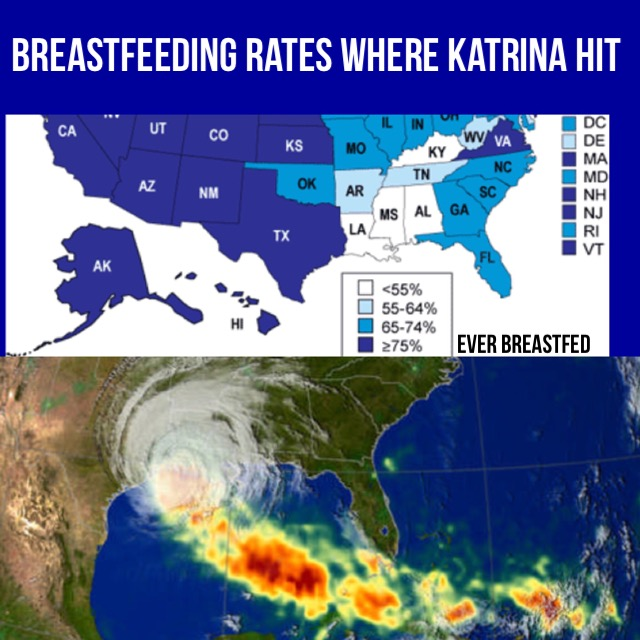
One of the biggest tragedies during Hurricane Katrina was that almost no breastfeeding mothers were found. One-third of Louisiana’s population was displaced, which was about 1,300,000 people, and more than 100,000 evacuees remained in shelters more than one month later.

The distribution of formula and bottles by aid workers during this time disregarded the importance of clean water and utensils to make feeding infants possible and safe, and the more time that passed, the higher the risks for infant mortality continued to climb.

According to the American Academy of Pediatrics, in any given emergency, clean drinking water and a sterile environment may be inaccessible. Even in a potentially less catastrophic emergency, such as being trapped in gridlock for several hours, access to water to make formula as well as the ability to clean and sterilize bottles or feeding utensils is not possible. Infants need to be fed every 2 to 3 hours. When disaster strikes, reality hits, and panic can ensue.

The WHO states that artificially fed babies have a 1300 percent increased risk of death from diarrhoeal disease as compared to babies that are breastfed. The WHO adds that babies who are artificially fed are inherently more vulnerable to disease because they do not receive the disease-fighting antibodies that are in breastmilk.

“In past emergencies, 12–75% of all babies have died, so any factor that increases disease transmission and reduces the ability of babies to withstand disease may well result in their death.” - World Health Organization

At the time of Hurricane Katrina, information was not readily available to support optimal infant nutrition; rescue workers were not trained in breastfeeding support and management. Overall, the distribution of formula discouraged breastfeeding, decreased mothers’ confidence, and increased the risk of infection, illness, and death.

The Clear Advantages of Breastfeeding During an Emergency

  • Provides comfort and relieves maternal anxiety
  • Protects against infectious diseases
  • Readily available
  • Nutritionally perfect
  • Perfect temperature
  • Fights Illness

The Disadvantages of Formula-Feeding During an Emergency

  • It may not be readily available
  • May become contaminated
  • Water mixed with powdered formula may be contaminated
  • There may be no means of refrigeration to preserve it
  • There may be no method to sterilize feeding utensils


While some strides have been made to educate about the importance of breastfeeding during disasters, the lack of normalcy is still present in our society and more efforts should be made to instill it in mothers, aid workers, and government agencies collectively. Milksharing or local donations of expressed milk should be a mainstream option to feed infants in dire cases.

Future natural disasters are inevitable and will continue to have a devastating effect on the economy and well-being of families. Protecting, promoting, and supporting breastfeeding during these natural disasters will help prevent long-term health and developmental problems that may occur as a result of alternative feeding methods. Encouraging breastfeeding will also lessen the economic blow, as the overall cost of the disaster is significantly reduced for both the families and societies affected. It is an investment that will pay for itself in more ways than one, several times over.

Contributing author: Samantha Johnson is a freelance writer, blogger, wife, and breastfeeding mom. Her Bachelor of Arts degree in journalism from California Baptist University has led to more than six years of full-time writing experience and countless exciting opportunities. Aside from writing, her passions include drawing, painting, iced coffee, reaching her goals, balancing life's priorities, and encouraging others. You can visit her blog at unlazylike.wordpress.com.

Saturday, July 18, 2015

Breasts Plan to Breastfeed--Don't Let Them Down

I think advocates have exhausted the mantra that human milk is best for human babies, but breastfeeding does not exclusively benefit baby. I believe Mom is often left out of the equation. In fact, if breastfeeding were only about the baby's nutritional needs, than perhaps someday there could be an adequate substitute--but it isn't.
Approximately sixteen weeks into pregnancy, a mom is notified via tender mammary glands, that she is, indeed, expecting. Her body is starting the preparation for future breastfeeding. An amazing, complex factory has commenced production of cells, aveoli, ductile work and Montgomery glands. There is even an increase in the pigmentation around the areola to create an obvious target for the baby once he arrives--make no mistake, the breasts are planning on breastfeeding.

Milk Synthesis explained 
http://www.thevisualmd.com/videos/result/milk_synthesis_pathway

The attention given to every detail is absolutely mind boggling. The stage is set in precise detail. The breasts have prepared for breastfeeding like an athlete prepares for the Olympics. They are focused on their one job, and poised to perform. Imagine the disappointment when they are "letdown" postpartum. They never get to realize their full potential. Who is speaking up for the rights of the ta-tas? They have painstakingly prepared for this precise moment for nine consecutive months. Not only is is disappointing, it also poses serious health risks. Just like atrophy sets in when muscles cease to do what they were designed for, abandoning breastfeeding creates serious complications as well.

What happens when breasts are told, "You're Fired!" and are not chosen to fill the primary feeding position? Well, it isn't pretty.

Following birth, Mom's uterus is in need of some serious repair. The best way to return this muscle to it's pre-pregnancy shape is to contract the muscle--a phenomenon that is executed through breastfeeding. This is the most effective way to strengthen the muscle and reduce blood loss. Moms should plan on breastfeeding for a thorough workout, after all, they cannot walk into a 24 Hour Fitness and use the "uterus machine" to tone up.

Recovery continues as the baby continues to breastfeed. Mom may experience significant weight-loss as she burns more calories breastfeeding. The benefits do not stop when baby weans, they continue for a lifetime.

It is as though Baby says, "Mom, I need you to be around a very long time. I need your lap to sit on and your hand to hold...I need your advice when I'm a teen and in my adult years...I need your hugs on birthdays and every morning...I need your kisses on my scraped knee and broken heart...I need you at my wedding and at childbirth...I need you to be the grandmother to my children; and here's how I will make that happen--breastfeed me."

If Mom chooses to breastfeed, Baby will protect her from many immediate and future ailments. Breastfeeding moms experience a reduction in breast, uterine and ovarian cancer. Breastfeeding also lowers the risk of postmenopausal osteoporosis. Breastfeeding moms profit from the hormone Oxytocin, which helps to stabilize moods.

I hope we are encouraging women to listen to their bodies and listen to their babies. They should be entitled to receive all the advantages and bonding associated with breastfeeding. I know not everyone has the opportunity or freedom to select breastfeeding and they must rely on milk donations, supplements or a combination of both. I sympathize with them and understand their plight personally, but still want to convey for those who can, that they (not only their offspring) will reap the rewards.
Order your copy of the poster above http://www.birthingandbreastfeeding.com/store.html

Breastfeeding is a relationship. A bond between Mother and Baby. A beautiful contract to support each other in health and well-being. Maybe breastfeeding and mothering isn't a thankless job after-all, maybe we just aren't making moms aware that their baby has a tremendous gift they want to give, but only by breastfeeding can it be received. Let's commit to empower moms and enable them to accept this life-giving gift.

Thursday, May 30, 2013

The Birth Doula-Helping to Ensure Breastfeeding Success in the Hospital

Joining a family for the birth experience is both a great honor and a great responsibility.  Doulas enter the most amazing place as they simultaneously witness and support in a miracle.  It is sometimes difficult to focus on the tasks and not get caught up in being merely a spectator in the blooming of a birth, but the focus comes with the realization that the goal is to support the family. A doula plays a crucial part in how the birth will be remembered and how breastfeeding will be initiated.  
Birth and breastfeeding are as closely related as a key to a lock.  Often, moms are discouraged by difficulty in breastfeeding which is often brought on by birth practices or protocols during the immediate postpartum period.  Many routine procedures jeopardize breastfeeding success. Having an understanding of how medications effect a baby can be a huge advantage to assessing the breastfeeding relationship.  Doulas need to keep a mental note of medications being administered and the type of birth a mom experiences in order to provide the best postpartum breastfeeding education and support.  A skilled doula can avoid long-term problems by anticipating possible consequences and formulating immediate solutions to common problems.

A doula can also be proactive by assisting in formulating the Birth Plan.  This is an excellent time for the birth assistant to explain all the procedures and the pros and cons of each intervention.  Once a mother's wishes have been spelled out, the doula is able to advocate for the family throughout the birth day. 

The keys to supporting a mom in the hospital begin before her first contraction.  Statistics show that most families reach their infant feeding decision prenatally.  It is important to offer education during prenatal visits with clients.  These scheduled visits are great opportunities to discuss what the client knows about breastfeeding.  One open-ended question I often begin with is, “What have you heard about breastfeeding?”  This question will often reveal fears, concerns, misconceptions and the mother's confidence level. 


Once the desire to breastfeed has been established, the doula’s role has a new facet.  The mom will rely on the doula to support her in this momentous decision. Breastfeeding is a brief event (in comparison to the entire life of an individual), that has life-long effects.  The research and resources about formula risk is abundant and breastmilk will insure protection from many childhood and adult health conditions.  I take breastfeeding support as seriously as all aspects of my work, and commit to helping a mom reach her breastfeeding goals—whatever they may be.

Observation is the first key to breastfeeding success.  Observations can even be made prenatally.  Statistically, obese, diabetic, and older moms (over 40) may have delayed Lactogenesis II (onset of copious milk supply).  Additionally, clients who birth cesarean may not experience fullness in the breasts until day four.  Being armed with this information is a huge advantage to the mom who is convinced she “has no milk” based on breast fullness postpartum.  Moms need to be reminded that the infant had a direct line to the all-you-can-eat buffet while in utero and does not enter the world starving. 

A doula’s immediate postpartum role is to encourage skin-to-skin and protect the “quiet hour” for bonding.  Doulas may encourage the mom to slightly recline, place Baby between the breasts (somewhat vertically) and assist as the baby scoots down to self-latch.  Doulas and hospital staff may offer additional assistance to the medicated mother if necessary. Most babies when placed skin-to-skin will initiate breastfeeding within the first two hours postpartum.  I encourage a "babymoon" much like a honeymoon where the family commits time and attention to love, learn and hold the new baby.

Medication taken during labor can also affect the breastfeeding outcome.  Natural pain management is the least likely to result in breastfeeding issues.  If medication is necessary, generally, the epidural is more desirable than anesthesia for c-section births.  The epidural allows for earlier contact with mom and longer nursing sessions.  The infant born via cesarean will often be sleepy and lethargic, especially if anesthetics were administered for a prolonged period.  Doulas can help with positioning, supporting the baby at breast, and helping to arouse the sleepy baby.

The baby who was exposed to narcotics during birth may be agitated and restless.  These medications are often administered with a promise to “take the edge off” during labor. Sometimes medical staff try to minimize the effects of labor medications, but it is important to understand that all medications can affect breastfeeding. Fortunately, with the support of a well-prepared doula, the transition from belly to breast can be smooth and natural. 


Monday, May 20, 2013

It's Time to Make "Doula" a Household Name


What is a doula?  

How many times has a doula been asked that question? It is a profession rarely highlighted in career choices and fewer people understand the role of a doula than that of a dog walker.  The services that a doula performs are fundamental to birth, yet even Micorsoft places a red, squiggly line under the word, expressing ignorance of the vocation.  

I was confronted with naiveté of society recently while attending an adult baseball game.  The pitcher threw a fastball to the batter who hit a line drive straight back to him.  The pitcher neither ducked nor got his glove up in time--taking the ball directly above his brow.  He went back, meeting the mound with all his weight.  There were gasps from the stands and players began to swarm around the injured pitcher.  Within seconds, as the huddled group decided how to respond, a voice projected towards all the on-lookers, and someone yelled, "Get Christy Jo, she works in a hospital!"  If it wasn't such a somber time, I would have burst out laughing.  I was sitting next to a friend who was a RN, yet they call for the Lactation Consultant/Doula?  What diagnosis did they expect?  The only response I could have offered (in my field of expertise) is, "Put some breast milk on it!"  Of course I can joke about it now since the player was transported to the hospital, had a few tests performed, observed for a few hours, and then discharged.  As I recount this story, I validate the need for education on the work and scope of a doula. What is a doula?
I could offer the text book definition: 
doula [ˈduːlə]
n
(Medicine/Gynaecology & Obstetrics) a woman who is trained to provide support to women and their families during pregnancy, childbirth, and the period of time following the birth
[from Greek doule female slave]
But that would only perpetuate the anemic understanding of the term.  A doula's skills and services are as varied as the women who perform them. To describe a doula as merely a labor assistant is equivalent to describing a sculpture, painter, metal smith and musician as an "artist." Does that tern explain or adaquately portray the gifts and talents of Picasso, Rembrandt, Degas or Michelangelo--absolutely not.  The general term is an insult to the master of the clay, dictator of the canvass and matriarch of the Renaissance.  An artist is so much more than the word suggests, yet, I suppose it is a starting point.


What Are a Doula's Qualifications?

There are some general attributes that can be given to most doulas.  Doulas receive specific education in the perinatal field.  Training can come in the form of mentor-ships or formal education.  Many doulas have completed a certification program that holds them accountable to the certifying agency.  In order to complete certification, students must complete numerous steps--all which enhance the skills and knowledge of the doula.  Certification may involve taking a specific training course, completing reading assignments, fulfilling observational tasks, attending coalition/support groups, role playing. accomplishing research projects and passing an exam.  Certified doulas are also required to re-certify for maintenance of the title.  


Doulas Should be Hired Early in the Prenatal Period

Doulas realize the importance of establishing a relationship with clients prior to attending their birth.  This is as very vulnerable time for a woman, and trust is of the most importance.  It is crucial to learn the family’s history, mom's preferences and develop a comfortable friendship.  Doulas often offer prenatal classes to their clients as part of the doula service.  Once a client explains her ideal birth, the doula can begin working towards that goal during the prenatal meetings.  Doulas may teach clients birthing and laboring positions or relaxing techniques that can be practiced between meetings. A well-prepared client is empowered and confident as the "birth day" approaches. The more comfortable the clients are with the doula, the more at ease they will be at the birth. The prenatal investment is paramount to a tranquil birth.

"My advice to every dad, 'Get yourself a doula'!" Johnathan F.


Doulas take the role of servant to heart, offering emotional and physical support throughout labor.  They are a valuable part of the team in a home birth, birth center birth or hospital birth. Whether a mom chooses a natural or medicated birth, a doula is equipped with information to support the family.  Even in the case of a planned or emergency C-section, a trained professional at a mom's side provides a calming effect for everyone present. 

Doulas often advocate for the family and remind the laboring mom or couple of their predetermined birth choices.  They guard the birth from distractions and intrusions.  Doulas anticipate the needs of the birth coaches and laboring mother--offering ice, wiping a brow, massaging feet and securing additional blankets--but most importantly, a doula is present.


In a hospital setting, nurses are required to complete so many routine tasks, that they are denied the luxury of lingering at the laboring mother's side; in contrast, the labor doula offers the security and comfort of continuous companionship. So often questions arise when the medical staff are not in the room.  A doula can help to answer questions and offer confirmation that birth is proceeding as expected.  A doula not only interprets the birth for those present, but also anticipates the most likely imminent events. I have had fathers watch in amazement as their soul mates go through a transformation that they could have never imagined; and with a few encouraging and assuring words, they can return to a state of awe rather than one of panic and disbelief.  

Partners frequently grasp for ways to offer support and comfort to their soul mates.  A doula helps to guide the process.  The doula also offers a second pair of hands for relaxation and massage as well as relief for a partner that may need a few moments to refocus.  Sometimes couples are more comfortable with the doula taking on a larger role in the production.  I have been at births where I have been asked to perform a monologue only calling in extras during specific scenes.  The couples had a well-thought out plan that involved the doula coaching and comforting Mom, providing direction and soothing measures.  Dad was free to record the event, contact relatives and whisper in his wife's ear.  A doula is a servant, performing any task that makes the birth more comfortable, enjoyable and memorable for her clients. 

There is no right or wrong way for the doula to assist, as long as she is working within her scope.  Doulas understand that the birth and the decisions are at the discretion of their clients, they just serve to make the transition form womanhood to motherhood as smooth and enjoyable as possible.   


Does a Doula Make a Difference?
Studies have shown that the use of
a Doula during labor and delivery can have
the following beneficial effects:

  50% reduction in the cesarean rate
  25% shorter labor
  60% reduction in epidural requests
  40% reduction in pitocin use
  30% reduction in analgesia use
  40% reduction in forceps delivery
  Improved breastfeeding
  Satisfaction with birth experience
  Decreased postpartum depression

*Adapted from Mothering the Mother--
How a Doula Can Help You Have a Shorter, Easier and Healthier Birth by M.H. Klaus, J.H. Kennell, and P.H. Klaus; Addison-Wesley Publishing Co., New York (1993).


Let a Doula Be Your Epidural

There are far more benefits to having a doula at a birth than there are to having an epidural--yet only one of these are talked about at hospitals, in moms groups or in the main stream media.  That needs to change! Let's remind moms that they don't need to--nor should they--enter this time alone or unprepared.  Moms can take birth back, and doulas can help.

Author's Note: I have been in the perinatal field for over a dozen years.  Originally, I entered the field as a Lactation Consultant.  Many of my breastfeeding clients had issues that originated in the hospital. I quickly realized I wanted to spend a more time in the area of prevention to avoid the numerous  postpartum visits where I spent days, sometime even weeks fixing what could have been avoided in the first place. 

More information about Christy Jo's Doula Services or Doula Connect (a service that matches clients with doulas) can be found on her website