Showing posts with label breast crawl. Show all posts

Saturday, October 8, 2016

When Natural Disasters Strike, Breastfeeding Matters

Hurricane Katrina NOLA.com
Earthquakes, floods, tornadoes, fires. Recent years have seen their share of natural disasters and emergencies which will only continue to occur with the passing of time. Even now, a State of Emergency has been declared for Hurricane Matthew, and heightened seismic activity at the Salton Sea has prompted scientists to warn of the elevated risk for “The Big One” at San Andreas fault.
Disasters and emergencies, while incredibly devastating, invoke a sense of camaraderie as people from all walks of life and differing backgrounds join together to help; to donate. While the intention is good, the protocol of infant feeding during natural disasters in particular needs dire improvement. This problem springboards from the lack of education on the importance of breastfeeding as a whole.
Hurricane Katrina shelter
Residents wait in line at the Superdome for shelter
during Hurricane Katrina. Image source: chron.com
Major health and aid agencies have come to a general consensus on how infant feeding issues should be addressed during disasters. They agree that the use of formula should only occur when mothers have weaned and relactation is not possible, or when the baby has lost its mother and wet nursing is not an option. They agree that ongoing support and assistance is necessary in such a case to limit the risks associated with artificial feeding, and that the distribution of breastmilk substitutes should be tightly controlled, carefully monitored and only provided to babies with a clear need.  
UNICEF, WHO, and the International Red Cross are active in alerting non-government organizations of the need to support breastfeeding and to be extremely careful in the distribution of breastmilk substitutes. Despite their efforts, and despite these guidelines, infant formula and bottles continue to be distributed unnecessarily during disaster situations.
During emergency situations, the cleanest, safest food is human milk.
Myth: Mothers who are under stress cannot breastfeed.

Fact: Mothers will continue to lactate in times of stress but will need adequate support.


Myth: If a mother is malnourished, she either cannot breastfeed or the milk she produces is poor quality.

Fact: Malnourished mothers or mothers with illnesses CAN provide healthy and safe milk for their babies.


The Problem with Formula Donations During Emergencies

One of the biggest tragedies during Hurricane Katrina was that almost no breastfeeding mothers were found. One-third of Louisiana’s population was displaced, which was about 1,300,000 people, and more than 100,000 evacuees remained in shelters more than one month later.
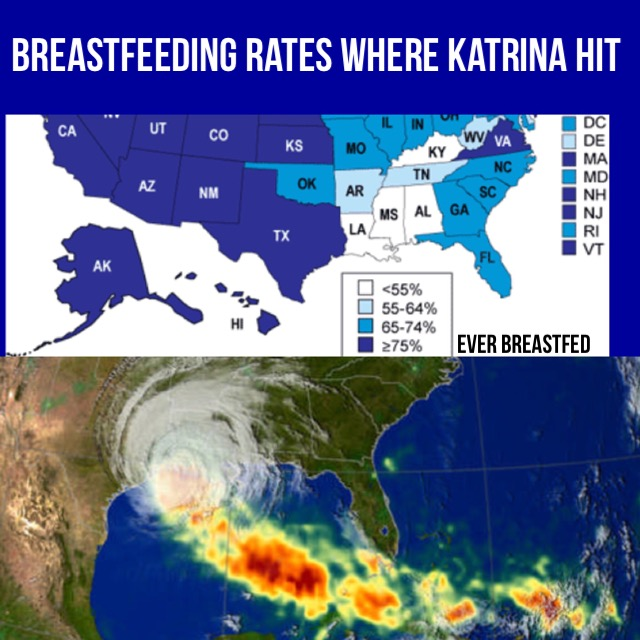
The distribution of formula and bottles by aid workers during this time disregarded the importance of clean water and utensils to make feeding infants possible and safe, and the more time that passed, the higher the risks for infant mortality continued to climb.

According to the American Academy of Pediatrics, in any given emergency, clean drinking water and a sterile environment may be inaccessible. Even in a potentially less catastrophic emergency, such as being trapped in gridlock for several hours, access to water to make formula as well as the ability to clean and sterilize bottles or feeding utensils is not possible. Infants need to be fed every 2 to 3 hours. When disaster strikes, reality hits, and panic can ensue.

The WHO states that artificially fed babies have a 1300 percent increased risk of death from diarrhoeal disease as compared to babies that are breastfed. The WHO adds that babies who are artificially fed are inherently more vulnerable to disease because they do not receive the disease-fighting antibodies that are in breastmilk.

“In past emergencies, 12–75% of all babies have died, so any factor that increases disease transmission and reduces the ability of babies to withstand disease may well result in their death.” - World Health Organization

At the time of Hurricane Katrina, information was not readily available to support optimal infant nutrition; rescue workers were not trained in breastfeeding support and management. Overall, the distribution of formula discouraged breastfeeding, decreased mothers’ confidence, and increased the risk of infection, illness, and death.

The Clear Advantages of Breastfeeding During an Emergency

  • Provides comfort and relieves maternal anxiety
  • Protects against infectious diseases
  • Readily available
  • Nutritionally perfect
  • Perfect temperature
  • Fights Illness

The Disadvantages of Formula-Feeding During an Emergency

  • It may not be readily available
  • May become contaminated
  • Water mixed with powdered formula may be contaminated
  • There may be no means of refrigeration to preserve it
  • There may be no method to sterilize feeding utensils


While some strides have been made to educate about the importance of breastfeeding during disasters, the lack of normalcy is still present in our society and more efforts should be made to instill it in mothers, aid workers, and government agencies collectively. Milksharing or local donations of expressed milk should be a mainstream option to feed infants in dire cases.

Future natural disasters are inevitable and will continue to have a devastating effect on the economy and well-being of families. Protecting, promoting, and supporting breastfeeding during these natural disasters will help prevent long-term health and developmental problems that may occur as a result of alternative feeding methods. Encouraging breastfeeding will also lessen the economic blow, as the overall cost of the disaster is significantly reduced for both the families and societies affected. It is an investment that will pay for itself in more ways than one, several times over.

Contributing author: Samantha Johnson is a freelance writer, blogger, wife, and breastfeeding mom. Her Bachelor of Arts degree in journalism from California Baptist University has led to more than six years of full-time writing experience and countless exciting opportunities. Aside from writing, her passions include drawing, painting, iced coffee, reaching her goals, balancing life's priorities, and encouraging others. You can visit her blog at unlazylike.wordpress.com.

Thursday, May 30, 2013

The Birth Doula-Helping to Ensure Breastfeeding Success in the Hospital

Joining a family for the birth experience is both a great honor and a great responsibility.  Doulas enter the most amazing place as they simultaneously witness and support in a miracle.  It is sometimes difficult to focus on the tasks and not get caught up in being merely a spectator in the blooming of a birth, but the focus comes with the realization that the goal is to support the family. A doula plays a crucial part in how the birth will be remembered and how breastfeeding will be initiated.  
Birth and breastfeeding are as closely related as a key to a lock.  Often, moms are discouraged by difficulty in breastfeeding which is often brought on by birth practices or protocols during the immediate postpartum period.  Many routine procedures jeopardize breastfeeding success. Having an understanding of how medications effect a baby can be a huge advantage to assessing the breastfeeding relationship.  Doulas need to keep a mental note of medications being administered and the type of birth a mom experiences in order to provide the best postpartum breastfeeding education and support.  A skilled doula can avoid long-term problems by anticipating possible consequences and formulating immediate solutions to common problems.

A doula can also be proactive by assisting in formulating the Birth Plan.  This is an excellent time for the birth assistant to explain all the procedures and the pros and cons of each intervention.  Once a mother's wishes have been spelled out, the doula is able to advocate for the family throughout the birth day. 

The keys to supporting a mom in the hospital begin before her first contraction.  Statistics show that most families reach their infant feeding decision prenatally.  It is important to offer education during prenatal visits with clients.  These scheduled visits are great opportunities to discuss what the client knows about breastfeeding.  One open-ended question I often begin with is, “What have you heard about breastfeeding?”  This question will often reveal fears, concerns, misconceptions and the mother's confidence level. 


Once the desire to breastfeed has been established, the doula’s role has a new facet.  The mom will rely on the doula to support her in this momentous decision. Breastfeeding is a brief event (in comparison to the entire life of an individual), that has life-long effects.  The research and resources about formula risk is abundant and breastmilk will insure protection from many childhood and adult health conditions.  I take breastfeeding support as seriously as all aspects of my work, and commit to helping a mom reach her breastfeeding goals—whatever they may be.

Observation is the first key to breastfeeding success.  Observations can even be made prenatally.  Statistically, obese, diabetic, and older moms (over 40) may have delayed Lactogenesis II (onset of copious milk supply).  Additionally, clients who birth cesarean may not experience fullness in the breasts until day four.  Being armed with this information is a huge advantage to the mom who is convinced she “has no milk” based on breast fullness postpartum.  Moms need to be reminded that the infant had a direct line to the all-you-can-eat buffet while in utero and does not enter the world starving. 

A doula’s immediate postpartum role is to encourage skin-to-skin and protect the “quiet hour” for bonding.  Doulas may encourage the mom to slightly recline, place Baby between the breasts (somewhat vertically) and assist as the baby scoots down to self-latch.  Doulas and hospital staff may offer additional assistance to the medicated mother if necessary. Most babies when placed skin-to-skin will initiate breastfeeding within the first two hours postpartum.  I encourage a "babymoon" much like a honeymoon where the family commits time and attention to love, learn and hold the new baby.

Medication taken during labor can also affect the breastfeeding outcome.  Natural pain management is the least likely to result in breastfeeding issues.  If medication is necessary, generally, the epidural is more desirable than anesthesia for c-section births.  The epidural allows for earlier contact with mom and longer nursing sessions.  The infant born via cesarean will often be sleepy and lethargic, especially if anesthetics were administered for a prolonged period.  Doulas can help with positioning, supporting the baby at breast, and helping to arouse the sleepy baby.

The baby who was exposed to narcotics during birth may be agitated and restless.  These medications are often administered with a promise to “take the edge off” during labor. Sometimes medical staff try to minimize the effects of labor medications, but it is important to understand that all medications can affect breastfeeding. Fortunately, with the support of a well-prepared doula, the transition from belly to breast can be smooth and natural.