Showing posts with label Birthing Bonding and Breastfeeding. Show all posts

Saturday, October 8, 2016

When Natural Disasters Strike, Breastfeeding Matters

Hurricane Katrina NOLA.com
Earthquakes, floods, tornadoes, fires. Recent years have seen their share of natural disasters and emergencies which will only continue to occur with the passing of time. Even now, a State of Emergency has been declared for Hurricane Matthew, and heightened seismic activity at the Salton Sea has prompted scientists to warn of the elevated risk for “The Big One” at San Andreas fault.
Disasters and emergencies, while incredibly devastating, invoke a sense of camaraderie as people from all walks of life and differing backgrounds join together to help; to donate. While the intention is good, the protocol of infant feeding during natural disasters in particular needs dire improvement. This problem springboards from the lack of education on the importance of breastfeeding as a whole.
Hurricane Katrina shelter
Residents wait in line at the Superdome for shelter
during Hurricane Katrina. Image source: chron.com
Major health and aid agencies have come to a general consensus on how infant feeding issues should be addressed during disasters. They agree that the use of formula should only occur when mothers have weaned and relactation is not possible, or when the baby has lost its mother and wet nursing is not an option. They agree that ongoing support and assistance is necessary in such a case to limit the risks associated with artificial feeding, and that the distribution of breastmilk substitutes should be tightly controlled, carefully monitored and only provided to babies with a clear need.  
UNICEF, WHO, and the International Red Cross are active in alerting non-government organizations of the need to support breastfeeding and to be extremely careful in the distribution of breastmilk substitutes. Despite their efforts, and despite these guidelines, infant formula and bottles continue to be distributed unnecessarily during disaster situations.
During emergency situations, the cleanest, safest food is human milk.
Myth: Mothers who are under stress cannot breastfeed.

Fact: Mothers will continue to lactate in times of stress but will need adequate support.


Myth: If a mother is malnourished, she either cannot breastfeed or the milk she produces is poor quality.

Fact: Malnourished mothers or mothers with illnesses CAN provide healthy and safe milk for their babies.


The Problem with Formula Donations During Emergencies

One of the biggest tragedies during Hurricane Katrina was that almost no breastfeeding mothers were found. One-third of Louisiana’s population was displaced, which was about 1,300,000 people, and more than 100,000 evacuees remained in shelters more than one month later.
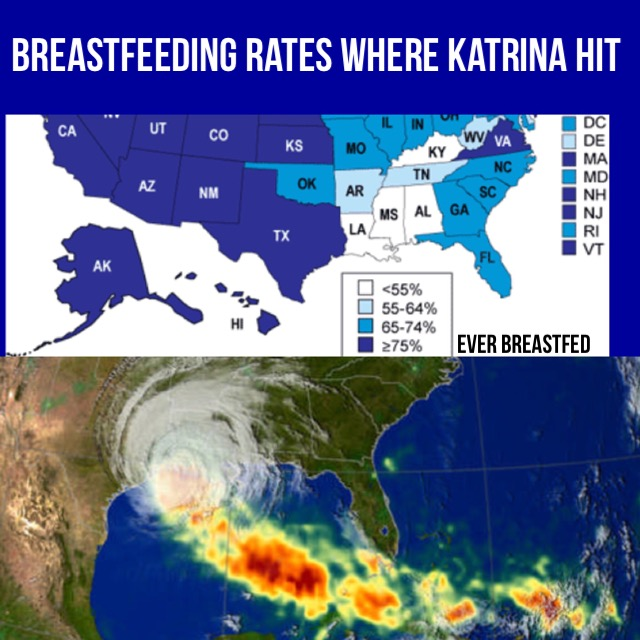
The distribution of formula and bottles by aid workers during this time disregarded the importance of clean water and utensils to make feeding infants possible and safe, and the more time that passed, the higher the risks for infant mortality continued to climb.

According to the American Academy of Pediatrics, in any given emergency, clean drinking water and a sterile environment may be inaccessible. Even in a potentially less catastrophic emergency, such as being trapped in gridlock for several hours, access to water to make formula as well as the ability to clean and sterilize bottles or feeding utensils is not possible. Infants need to be fed every 2 to 3 hours. When disaster strikes, reality hits, and panic can ensue.

The WHO states that artificially fed babies have a 1300 percent increased risk of death from diarrhoeal disease as compared to babies that are breastfed. The WHO adds that babies who are artificially fed are inherently more vulnerable to disease because they do not receive the disease-fighting antibodies that are in breastmilk.

“In past emergencies, 12–75% of all babies have died, so any factor that increases disease transmission and reduces the ability of babies to withstand disease may well result in their death.” - World Health Organization

At the time of Hurricane Katrina, information was not readily available to support optimal infant nutrition; rescue workers were not trained in breastfeeding support and management. Overall, the distribution of formula discouraged breastfeeding, decreased mothers’ confidence, and increased the risk of infection, illness, and death.

The Clear Advantages of Breastfeeding During an Emergency

  • Provides comfort and relieves maternal anxiety
  • Protects against infectious diseases
  • Readily available
  • Nutritionally perfect
  • Perfect temperature
  • Fights Illness

The Disadvantages of Formula-Feeding During an Emergency

  • It may not be readily available
  • May become contaminated
  • Water mixed with powdered formula may be contaminated
  • There may be no means of refrigeration to preserve it
  • There may be no method to sterilize feeding utensils


While some strides have been made to educate about the importance of breastfeeding during disasters, the lack of normalcy is still present in our society and more efforts should be made to instill it in mothers, aid workers, and government agencies collectively. Milksharing or local donations of expressed milk should be a mainstream option to feed infants in dire cases.

Future natural disasters are inevitable and will continue to have a devastating effect on the economy and well-being of families. Protecting, promoting, and supporting breastfeeding during these natural disasters will help prevent long-term health and developmental problems that may occur as a result of alternative feeding methods. Encouraging breastfeeding will also lessen the economic blow, as the overall cost of the disaster is significantly reduced for both the families and societies affected. It is an investment that will pay for itself in more ways than one, several times over.

Contributing author: Samantha Johnson is a freelance writer, blogger, wife, and breastfeeding mom. Her Bachelor of Arts degree in journalism from California Baptist University has led to more than six years of full-time writing experience and countless exciting opportunities. Aside from writing, her passions include drawing, painting, iced coffee, reaching her goals, balancing life's priorities, and encouraging others. You can visit her blog at unlazylike.wordpress.com.

Saturday, December 28, 2013

Teaching Breastfeeding through Simple Analogies

We have to realize how vague our breastfeeding descriptions are to those who are unfamiliar with "normal breastfeeding behavior." Statements like, "babies breastfeed often" or "expect baby to wake frequently" can be misinterpreted based on the mom's expectations and definitions of the terms. The more specific lactation educators and consultants can be, the more successful moms will be. I try to use one of the "7 Laws of the Teacher": Teach from the Known to the Unknown.

Analogies can bring education to the forefront and help new parents relate to breastfeeding in a tangible way. I have shared these analogies or "advertisements" over the past year, but thought I would gather a few of them up and share them in one blog. I hope these analogies help others to educate on breastfeeding and convey the message that breastfeeding is the standard infant feeding practice.

I often describe breastfeeding anatomy and philology with house-hold items moms are familiar with. They may not have studied pictures of Dr. Coopers's Anatomy of the Breast, or read Dr. Hartman's research on the Mammary gland, but they have handled a bottle of glue.

Different posters convey the same message.  Having a variety of presentations can help reach the visual or auditory learner.  Some people like a quick, easy-to-read visual, while others prefer more detail. Advertisers state that a message must be seen at least ten times by an individual before it is "recognized." I think many educators can relate to this statistic.  I often feel like I am saying the same thing over and over again.
Unfortunately, some moms have been told that something is "wrong" with their breasts.  It is easy to blame a vulnerable, hormonal postpartum mom for difficult latch issues.  I like to remind moms that the baby doesn't come out of the womb, look at her breasts and announce, "those aren't like the ones I've seen in magazines." Babies have no basis for comparison.  There is a huge variation of nipples across the land and this could be a problem if babies were meant to "nipple" feed, fortunately for all the nipple challenged mommies out there, babies "breast" feed. I tell moms that nipples are like snowflakes--there are no two exactly alike. 


Anatomy concerns span from nipple formation to breast size. This is an easy description of "cup" size that everyone can relate to. 
Once moms gain the confidence that they will have what it takes to breastfeed, the next obstacle is milk supply. If I had a nickle for every time I heard the statement, "your milk hasn't come in," I would be a millionaire. 

I remind mothers that even though their meals were withheld from them, the baby had a steady supply of nutrient.  I sometimes joke that if they had been at the Home Town Buffet all day, they wouldn't be hungry right away either.  I encourage them to practice skin-to-skin, nuzzling, cuddling and offering the breast; but not be be discouraged if the baby is not ferociously hungry or "crawling to the breast right away.  In fact, the Breast Crawl has been documented to take up to 90 minutes to spontaneously occur. 

I invented the Lactation Lanyards as teaching tools to help with bedside education.  Seeing a formula bottle gives the impression that the baby should consume the amount in the container.  It is empowering to show a mom an accurate size of the newborn's stomach capacity.  The Lactation Lanyards are available from the Birthing, Bonding and Breastfeeding Store. 

Once a mom understands that her body is not only capable of growing her baby, it is also capable of 
nurturing her baby, the next obstacle is often overcoming any difficulties.  Prevention is key.  The first preventative step is not giving into the recommendation to bottle feed, or offer "just one bottle."
What about the accurately diagnosed "insufficient mammary tissue" or complications from breast surgery. What are those moms to do?  We have set the options as "breast or bottle" rather than "breast AND bottle." Some is still better than none, and this analogy points to that truth. 

I have many other posters and reminders about breastfeeding and breast milk.  I am working on my 2014 analogies.  Feel free to share misconceptions that frustrate you in the lactation field.  I may be able to make a visual to correct the erroneous advice. I hope you will join me on my Facebook Page: Birthing, Bonding and Breastfeeding and share some of the evidence-based information we post with others. Some of the posters are available for framing from the BBB Store

Happy New Year and let's work together to tackle myths and fears in 2014!

Friday, May 17, 2013

Breastfeeding Moms Have a Target on Their Breasts

The national increase in breastfeeding rates has caused the formula companies to stand up and take notice.  What is great news for moms, babies and society could prove disastrous for formula companies and their stock holders--unless they can grab part of the growing market.  

Formula companies, like most thriving companies, strive to make a profit and constantly plot how to increase their earning. Some companies do this in conscionable ways while others are not so scrupulous--allowing visions of profit to cloud their judgement, they tend to concentrate on profit regardless of quality or health implications. Any assumption that these companies have the best interest of baby in mind is ludicrous. They continue to use the cheapest ingredients (corn syrup, vegetable oil, sucrose, etc) to allow for greater income--the bottom line, their loyalty is to their stock holders and wallets, which leads to many of their marketing strategies. 

The earlier a company can obtain a loyal customer the better.  Many ads and products vie for the prenatal shopper. Brand loyalty can begin with a selection of prenatal vitamins or supplements.  Many pregnant women are succumbing to the offers of registering for baby formula for baby showers and collecting coupons before they even deliver a baby.    


Formula companies previously used more passive marketing techniques such as offering free feeding advice on warm lines, suggesting formula for moms on the go, or offering quality gifts to new moms; but the days of subtleties are over.  The breastfeeding market has become too large to ignore, so "if you can't beat them, market to them." 
Formula advertisers are the kings of spin.  Moms have switched to formula after the huge marketing campaign announcing that breastfed babies need a Vitamin D supplement since breast milk does not contain the sunshine vitamin.  Of course, none of the ads reveal that breast milk was not meant to contain Vitamin D, which ideally comes from the sun. Since formula contains it, mothers began to question whether or not their milk was complete--the marketing strategy paid off, consumers were either purchasing formula containing Vitamin D or the Vitamin D supplements (manufactures by Enfamil) that state clearly on the box, "Essential for all Breastfed Infants." Of course the box top boasts, the "brand recommended by Pediatricians."

Perhaps the most disturbing trend in formula marketing occurred this month with the release of a new product directly targeting and undermining breastfeeding moms.  The May 11, 2013, release of a Similac for Supplementation confirms the company is desperately trying to increase its customer base.  This blatant attempt to sabotage the breastfeeding relationship is outrageous.  This new product states, "for breastfeeding moms who choose to introduce formula" compared to the other formulas which are only for "formula moms who choose to introduce formula?" This is a pathetic bid for the breastfeeding audience.  Unfortunately, it could just work, especially since this message is being perpetuated by a new study released two days later in Pediatrics.  The article's release date (occurring the same week this formula hit the shelves) is highly suspect.  It may seem like a conspiracy theory, but as well-equipped as the strategists are, the timing is not a coincidence and neither is the correlation between Abbott and the co-author of the study, who was previously employed by the maker of Similac.

The timing could not have been better orchestrated. It would be interesting to see if an advertisement for Similac ran in some of the major papers who posted the flawed supplementation study.


Formula companies seem to have an uncanny way of acquiring prestigious spokespeople for free. First, the doctors in the hospitals, now researchers for Pediatrics. No wonder the companies boast billions in profit annually, they have inside help.

The flawed, and poorly-constructed study published by Pediatrics sent the media on a sharing frenzy. The article made its way into nearly every large newspaper with headlines proclaiming that formula helps to breastfeed (an oxymoron exemplified).  Similac, Enfamil, and other artificial human milk companies could not have been handed a better gift. Few editors critiqued or even read the study prior to plastering the headlines across front pages.  The study, released online May 13, 2013, and published in Pediatrics, consisted of forty subjects-- an anemic sample size. The conclusion, after confirming that  15 of 19 mothers were still breastfeeding at 3 months, compared to 8 of 19 in the control group--a difference of 7 babies--was that babies given formula continue to breastfeed at higher rates. Not only was the study not supported by a clear hypothesis, the subjects were not homogeneous.

The clear conflict of interest was also document by a disclosure statement by the co-author, who "served as a paid consultant for Abbot Nutrition, Mead-Johnson, Nestle SA and Pifzer Consumer Products." Obviously, he must have a bias towards the necessity of formula to serve as a consultant for these companies. In fact, a more responsible study could have centered around supplementation with donor milk, if marketing formula was not one of the goals of this study. Pediatrics and its peer review council will surely continue to come under fire for publishing such an insult to true research. They acted in an irresponsible and unethical manner by endorsing this premature study. Although much of the damage has irreversibly been done, there are several rebuttals and informative articles being shared that are well thought out and deserve recognition   It is unfortunate indeed that newspaper editors will not be publishing any of them.  Dr. Alison Stuebe a member of Breasfeeding Medicine provides a response to the published study. Dr. Jack Newman added valuable insight to the study by posting his own commentary. 

As a service to breastfeeding mothers, and a way to expose the flawed research Birthing, Bonding and Breastfeeding conducted a survey asking mothers to respond if they were able to exclusively breastfed without formula supplementation. Within 24 hours over 340 moms confirmed their breastfeeding relationship was protected by choosing not to supplement.  Maybe from this result we could conclude that 99% women who use Facebook exclusively breastfeed. As ridiculous as this statistic is, it shows the parallel to how numbers can be manipulated and the erroneous conclusions which were drawn from the Pediatrics study.

Formula companies are missing out on a large portion of the infant-feeding market. Breastfeeding moms stay vigilant.  If you desire to breastfeed exclusively, the evidence is overwhelming in support of avoiding supplementation.  Babies are born to breastfeed and the protecting the relationship by keeping Mom and Baby together is the best practice for success.  Women who need additional support or medical advice should consult with their breastfeeding-friendly physician, Lactation Consultant and Peer Support Groups.


Editor's Note: I hope we can promote the message that moms do indeed have the milk they need when their babies are born. Products and flawed studies continue to undermine instinct and nature. We need to dispose of the idea that milk will "come in" or that mother's around day 3...engorgement does not have to happen, and if any more milk were available on day one, theoretically the baby could overfeed since all he wants to do is suck! We don't need to "wait" for anything. Just keep the dyad together and all the "issues" can resolve themselves.

Thursday, March 22, 2012

Facebook Censored Me

I put a lot of eggs in one basket--the Facebook basket.  I liked the simplistic style of the site and the freedom to create my "own" page and network with like-minded people.  I knew together we could change the world.  The momentum was building.  I had connected with over 3,500 friends and my Birthing, Bonding & Breastfeeding Page was reaching an excess of 700,000 people regularly.  We were pushing the pendulum of infant feeding into the direction of breastmilk and I was riding the wave.  Well, yesterday it was too much for "Big Brother."  My account was disabled, my pages removed, my events canceled, and my friends left wondering how I had vaporized overnight.  I may be hidden for now, but no worries, I am like the tempest under the sea. It may look as though the waters are still, but beneath the surface I am still churning with ideas and possibilities.  I will ride this wave again.  I am working on a blog from my website right now and hope to have it up soon...I was simplistic to think that Facebook was actually allowing me to create my "own" page.  I do appreciate the social networking opportunity and have requested my page be reinstated.

Here is my plea and reply to Facebook: I am assuming my account was disabled due to breastfeeding photos. I have not received a warning and I did not believe they were in violation, since the "nipple" was not showing. On my stats report 98% of my audience is women, with the exception of a few professionals in the pediatric and OB world, and these photos were not intended to violate a policy, but encourage a community to provide healthy, nutritious food. Please be specific as to what you do not want me to post. I did have someone say FB would probably take the photo down, but I did not think it was policy to remove an account. I need access so I can cancel my Facebook ads for the courses I am advertising and collect my emails. If you decide to close my account, it would be more professional to allow me to explain to my fan base another method to reach me. Please advise and please be specific as to what you do and do not allow. I know this has been a controversial topic for Facebook and I have seen the media coverage. I am not posting pornography-- and to insinuate as much is very offensive to me. I would be happy to share more about my stand on lactation if you would like to explore this topic. Thank you for your understanding. Christy Jo, IBCLC, CD(DONA). Also, as you may notice I am an International Board Certified Lactation Consultant and Certified Birth Doula, so my page will reflect these two professions. I am NOT a person posting images to an audience that does not appreciate the mother/child bond.

The photo that caused the world to stop and for me to be banned is posted here...and this one will not be removed because the author and contributor fully supports this photo.

 My caption read something to the effect that although yesterday was the first day of spring, I captured the best spring photo of the year at the Pass Area Breastfeeding Cafe...

Stay tuned. I will keep you all informed.  Nothing would please the formula companies more than to "divide and conquer"...

In the meantime, I can still be reached at mommymilk@msn.com, and from my website www.birthingandbreastfeeding.com.

I feel like every mother who has been told to cover up, hide or leave while breastfeeding--this has to stop!