Thursday, March 22, 2012

Facebook Censored Me

I put a lot of eggs in one basket--the Facebook basket.  I liked the simplistic style of the site and the freedom to create my "own" page and network with like-minded people.  I knew together we could change the world.  The momentum was building.  I had connected with over 3,500 friends and my Birthing, Bonding & Breastfeeding Page was reaching an excess of 700,000 people regularly.  We were pushing the pendulum of infant feeding into the direction of breastmilk and I was riding the wave.  Well, yesterday it was too much for "Big Brother."  My account was disabled, my pages removed, my events canceled, and my friends left wondering how I had vaporized overnight.  I may be hidden for now, but no worries, I am like the tempest under the sea. It may look as though the waters are still, but beneath the surface I am still churning with ideas and possibilities.  I will ride this wave again.  I am working on a blog from my website right now and hope to have it up soon...I was simplistic to think that Facebook was actually allowing me to create my "own" page.  I do appreciate the social networking opportunity and have requested my page be reinstated.

Here is my plea and reply to Facebook: I am assuming my account was disabled due to breastfeeding photos. I have not received a warning and I did not believe they were in violation, since the "nipple" was not showing. On my stats report 98% of my audience is women, with the exception of a few professionals in the pediatric and OB world, and these photos were not intended to violate a policy, but encourage a community to provide healthy, nutritious food. Please be specific as to what you do not want me to post. I did have someone say FB would probably take the photo down, but I did not think it was policy to remove an account. I need access so I can cancel my Facebook ads for the courses I am advertising and collect my emails. If you decide to close my account, it would be more professional to allow me to explain to my fan base another method to reach me. Please advise and please be specific as to what you do and do not allow. I know this has been a controversial topic for Facebook and I have seen the media coverage. I am not posting pornography-- and to insinuate as much is very offensive to me. I would be happy to share more about my stand on lactation if you would like to explore this topic. Thank you for your understanding. Christy Jo, IBCLC, CD(DONA). Also, as you may notice I am an International Board Certified Lactation Consultant and Certified Birth Doula, so my page will reflect these two professions. I am NOT a person posting images to an audience that does not appreciate the mother/child bond.

The photo that caused the world to stop and for me to be banned is posted here...and this one will not be removed because the author and contributor fully supports this photo.

 My caption read something to the effect that although yesterday was the first day of spring, I captured the best spring photo of the year at the Pass Area Breastfeeding Cafe...

Stay tuned. I will keep you all informed.  Nothing would please the formula companies more than to "divide and conquer"...

In the meantime, I can still be reached at mommymilk@msn.com, and from my website www.birthingandbreastfeeding.com.

I feel like every mother who has been told to cover up, hide or leave while breastfeeding--this has to stop!

Thursday, December 15, 2011

Formula Companies Dare to Compare Imitations to the Real Thing

This post is about advertising, marketing and deception.  We as educators, public health professionals, moms, citizens, consumers, tax payers, etc.  have to demand honesty in advertising--especially from the formula companies.  These companies use inferior ingredients, cut corners in production, and then lie about its value, causing customers to flock to the registers with complete peace of mind.  As consumers, we question the quality of what we purchase and we want what we pay for...then there's formula...


I made some tongue-in-cheek posters last week.  I am a very visual learner, so I created a visual.  I was attempting to show the stark difference between formula and breastmilk in a vivid, humorous way, but the humor was lost on some.


My posters showed the stark contrast between artificial infant milk and breastmilk.  The superiority of breastmilk is not a new concept, but rather a well-documented, well-established, scientific fact. The two are NOT created equal.  In fact, by law, every can of formula must explain that breastmilk is superior to the product contained therein.  One is a man-made, synthetic recipe; the other a natural, organic species-specific food.  Just like vitamin C tablets are not as potent or healthy as natural vitamin C from real fruit consumed; formula (artificial breast milk) is not as healthy as natural, species-specific breastmilk.


Most of the people who viewed the photos I posted gave it a "thumbs up" and some re-posted. Facebook is pretty good at tracking where posts travel via shares and the subsequent comments.  It was the dialogue that surfaced on some of my friends' pages that truly concerned me.  I realized for the first time how successful the formula companies are at not only dominating the infant feeding market, but also controlling the critics that may voice any opposition.  They conjure up feelings of guilt, anger, fear, disappointment and frustration--not for their product or marketers--but at those who may want to point out that their product is inferior...how did they accomplish that?


One irate commentator "shouted" obscenities and cursed the person who made the poster...strong, emotional response--was this response to the false advertising and implied similarities of formula and breastmilk?  No, as far as I could tell, the reader took offense at what she perceived the message insinuated...that she was a "bad" mother. Nothing could be further from the truth.  I even prefaced the ad with the following remarks
"Just a visual reminder that no matter how the formula companies try to package it, formula and breastmilk are NOT created equal...another thought on the deceptive advertising of formula...(not-and never will be-an attack on those who use it...)"

If a mom gives her infant formula to ensure survival she is definitely a good mom!  There are many legitimate reasons to use or supplement with formula (adoptive moms, foster moms, dads with custody, moms on certain medications...all rely on the nutrition adequacy of artificial infant milk), but still the reader saw:  formula=bad mom; breastmilk=good mom; and I was absolutely, positively judging them!  When a company can cause formula-using moms to take things personally they have achieve a great accomplishment. These companies have undoubtedly succeeded in attaching feelings to facts and substitute perception for reality.


Then there was responses from colleagues in the lactation field.  A couple stated that although they know the risks of formula feeding, they anticipated that people might be offended and riddled with guilt if they were to share my photo on their wall.  Now, this is where the formula companies really hit the jackpot.  Not only do they promote their product, but they also have successfully silenced the opposition.  Really?!  Professionals can't share that there are risks to formula-feeding without retaliation?  Are we free to share risks of not using a car seat or feeding infants honey, egg whites and peanut butter?  What if parents want to give these foods to their children?  Does that mean I am prohibited to share the information for fear of causing guilt? Of course not, but these other safety and feeding recommendations do not elicit the same emotional response the formula warnings do.


It appears as though formula companies have even found a way to convince breastfeeding advocates to keep silent about opinions and concerns.  Even as I write this, I have a bit of fear and trepidation about how this blog will be received.  Will people understand that I want to educate, and that my heart is in helping moms regardless of what their feeding choice is?  Will readers understand I am campaigning for honesty in advertising, or will I fall victim to the scandal that all opposition is insensitive and cruel?  I really am at a loss for how to change perception.  I hope others will help me turn the tide of perception by sharing this post.


What other company can get the loyal consumers on board and silent the opposition? Formula is a taboo subject to discuss in any circle. It has a protective barrier around it and is off-limits when it comes to criticism.  How did they ever achieve this marketing phenomenon?


I am also a bit perplexed and maybe even in awe at how the big formula companies have succeeded in promoting their imitations as "close to the real thing." No one believes that artificial infant milk is as good as breastmilk, but the nation accepts that it is "close enough."  I have to congratulate the conglomerates for their marketing genius and their ability to control perception.


I often stand in front of a group I am teaching and take a side step to my left and boldly announce, "I am now one step closer to China." Of course, I am no where near China, but one step closer.  Recently, I created this poster to convey the same message:


Here's another way for me to put this in perspective.  If a young couple walked into a jewelry store, while window shopping for an engagement ring, and a savvy salesman produced the sugar-coated ring pop with the description that it is "closer to a diamond than ever before," the customers would be outraged, insulted and storm out of the shop (of course the guy may still nonchalantly ask, "how much for the beautiful topaz").  The point is, we are wise to manipulation--especially from salespeople. The candy sentiment may be beautiful, shiny, slide nicely onto the ring finger, but it is not the same as a diamond--and how dare a jeweler insinuate that it is!


Would honesty be appreciated?  Absolutely...the same salesman could have said, "I have this replica that could serve the purpose of a symbol during the nuptials.  It isn't a diamond.  It is made of hard sugar, but you can use it as a stand in."  Then the couple could make an informed decision.  Most would prefer the diamond, but no one but they know all the circumstances.  Maybe a diamond is not an option.  Perhaps the bride has adverse reactions to metal and the plastic alternative is perfect!  They can confidently select the confectionery token without any guilt.  Content with their choice, they are still happy for those who can buy diamonds and understand that diamonds are superior, they do not try to argue the incredible investment that ring pops are and become outraged when anyone suggests that diamonds are superior. It would be ludicrous.


Take the next scenario.  A customer steps onto a used car lot.  Just the location puts people on the defensive by anticipating lies or stretching of the truth.  I'm not saying it's right or even warranted, just a matter of  car lot facts. The car salesman approaches the on-looker with a beauty to sale.  It has four wheels, a new paint job, will get you where you need to go and is "just as good as" the Lamborghini parked adjacent.  Really, who are you kidding?!  Consumer Reports are out and the little, plastic toy does not beat the sports car in any category (well, except MPG--which could actually be a good selling point in this gas war).  The real kicker comes with the sticker price...the dwarfed vehicle is actually priced higher.  The salesman blames inflation and the premium parts that have been used in construction.  Once again, no sale.  We are not going to be duped by a smooth talker.  We are going to look under the hood, kick the tires, and we may in all actuality purchase the little car...not because it is better--or even as good as--the hot rod, but because we need transportation and it is a viable option, but not because we "bought the lie."


Now, let me attempt to share the how these same analogies are used in formula promotion. The impracticable, ridiculous sales tactics mentioned above are laughable, but when marketing experts use them to promote formula, they now miraculously work!  The company passes off an inferior product as the real thing.  Customers are promised that it is "closer than ever to breastmilk."


How can they make these unsubstantiated claims?  Professionals working in the advertising world will attest that these phrases can be legally used if even the color is closer to breastmilk than it was previously.  The American Academy of Pediatrics, World Health Organization, UNICEF and the Department of Public Health all try to expose the deceptive marketing to no avail. These companies seem to be untouchable--even with facts.


Not only are established organizations' warnings rejected, friends and family attempt to share the truth about formula and the "Ring Pop crowd" embraces a mob mentality.  All of the sudden well-meaning friends are labeled "Breastfeeding Nazis" or "Lactivists."  Why is the truth so threatening?  Why would sharing the truth be interpreted as "making formula-feeding moms feel guilty"?


Here's a confession, just because I feel like readers may think I cannot relate.  I formula-fed my first child.  Not exclusively, I breastfed when it was convenient. Do I feel guilty when I hear how certain risks are increased with formula-feeding.  No, absolutely not.  I was convinced that formula and breastmilk were equal.  My nurse gave my son formula...she was older, "wiser" and had more children than I, so I deferred feeding to the lady Nightingale.  Now, I am upset that no one shared the truth with me. No one said the manufacturers cut corners, use inferior ingredients and market their product in order to please the share holders because it is a commodity that people heavily invest in...that would have been helpful.  I also put my son on his belly to sleep--another sign of the times.  I would do things differently now.  A lot of us would.


I have friends, family and clients that have had to use formula to feed their infants.  They do not feel guilty either.  It is a matter of fact.  They almost all would have preferred breastmilk, but it wasn't an option.  They knew the facts, were informed and also admit that scientists and other experts are correct in stating that breastmilk is the best choice. They are not part of the crowd that takes remarks personally.


Remember, by law every formula company has to confirm that breastmilk is superior to formula.  They have to print it right on the packaging labels, but do we get angry at the formula companies for this atrocious declaration? No, we direct our anger at a friend, family member or random individual that posts something on Facebook.  Wow, how do they do it?


Why have my ads elicited such emotional responses from some people?  Once again, I think it is part of the marketing.  


Please indulge me as I share another personal analogy of artificial food.  TPN  (Total parenteral nutrition) keeps getting improved upon...it is "closer than ever to nutritious food."  My dad had to be on it to get nutrients that he couldn't get by eating food, we appreciated the medical advance, but wouldn't have chosen it as our first choice, we knew food was preferable...it was just a matter of fact that we would need to use it to replace food to sustain life...we didn't feel guilty for using the TPN, or offended when professionals explained there were risks to using TPN as a food alternative, I understood it was lifesaving, but I was also happy for the rest of my family that could eat whole food...no one ever tried to convince us that TPN was equal to whole food...doctors and nutritionists were very transparent. Why is formula any different?


These are some final remarks and observations that I believe help the formula companies perpetuate a feeling of guilt when someone mentions the formula vs. breastmilk topic.  Moms feel guilty. That is a fact. Formula companies know this and they take advantage of moms during a vulnerable time in their lives...they play on a temporary weakness.  Moms assume the "fight or flight mode" and fight off a perceived attack...guns are cocked and everyone is ready for a fight...we will defend ourselves at all costs...good meaning friends must also be aware of this delicate time in a mother's life and assume a protective role as we educate.  That may seem like an oxymoron, but it is possible and preferred. 


How else can we combat the advertising moguls?  We must figure out a way to remove feelings from formula.  Just like readers had to try to remove feelings from fact as this article was being read.  It's difficult because perception is reality.


So what can we say about formula?  The truth.   formula was created to sustain life by trying to replicate breastmilk, much like TPN is used, but that does not make it the same as breastmilk...education and truth can go along way, and everyone deserves to be informed...

Sometimes there is no choice, but given a choice, it only makes sense...

I hope this doesn't come across as segmented.  I have a lot of thoughts and this blog has taken way too much time to compose, but I have been cautious and rewritten it a few times.  I will just have to submit it to the public after I make a final note to my lactivist friends: we must be extremely cautions to never confirm what the formula companies try to insinuate: that guilt and fear, depression and anger should be directed at lactation consultants.  If we make clients defensive, we are promoting the formula companies agenda.  We must be honest, sincere, gentle, supportive and loving (in fact, maybe even a little more than we naturally are).


Hope this provided some food for thought...
Christy Jo Hendricks, IBCLC, RLC, CD(DONA), CAPPA CLE Faculty


Hope you can join me for a lactation training in the future...together we can make a difference
http://www.birthingandbreastfeeding.com/

Wednesday, September 21, 2011

Formula Marketing Exposed

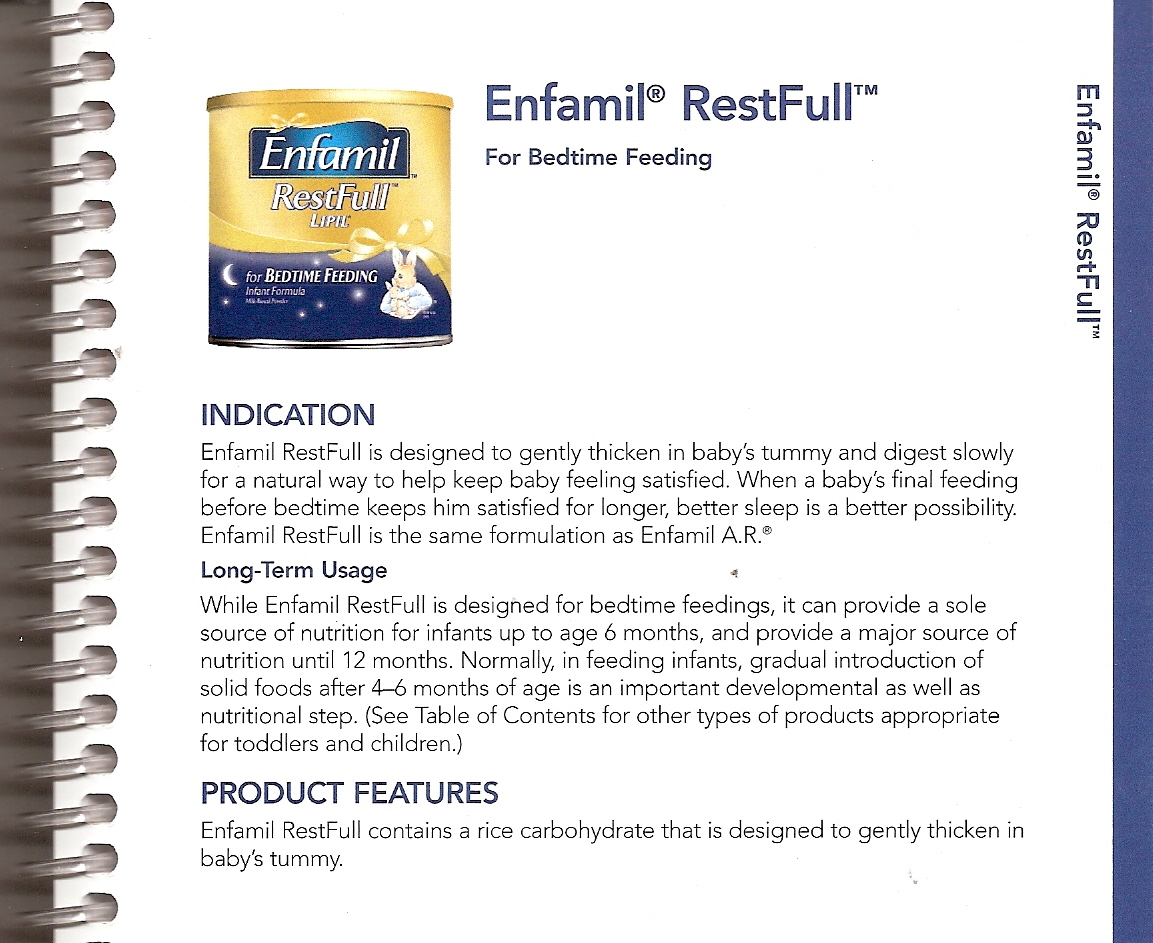
The 2010 Pediatric Products Handbook by Mead Johnson boasted of a "new" formula.  What is this brand new miracle in a can?  It's a sleep aid for children.  Well, it doesn't read exactly like that, but the actual words under "Product Features" are even more frightening.  I photographed the page, because as skeptical as I am, I would want to see it for myself and I believe my readers deserve the same consideration.
The product, Enfamil Restful "contains a rice carbohydrate that is designed to gently THICKEN IN BABY'S TUMMY."  They say it like it's a good thing!   Enfamil is marketing this product "For Bedtime Feeding."


The product claims that this is a "natural way to help keep baby feeling satisfied"...it's all there, read it...as many times as it takes to believe it.  Since when is throwing starch into a bottle "natural"?  
As you are still shaking your head, read the section about "Long-Term Usage"...yep, they say it..."it can provide a sole source of nutrition for infants UP TO AGE 6 MONTHS! Moms are being encouraged to start their newborn out on this stuff in order to make "better sleep a better possibility."  This formula is also available at local WIC agencies.  I think more counseling needs to be done during appointments concerning this product.

What problems do I see with this marketing scheme?  Where do I start?  First, we are setting moms up to think babies are supposed to sleep through the night.  Most of us know, or have heard, about the importance of brain development during the waking hours.  We should not encourage newborns to go several hours without waking right after they are born.  This is detrimental to their growth and development.

Also, formula is supposed to mimic the gold standard, which of course is human milk.  What do we know about human milk and digestion?  The proteins in breastmilk are easily digested and human milk is processed quickly--requiring regular feedings (small, frequent meals--spaced out throughout the day--is even a recommendation for children and adults).  These small, regular feedings do not require the stomach to stretch to hold an abundance of food that must be processed over a long period of time.  Formula is far-from replicating breastmilk in this instance.

This type of formula and teaching is contributing to the obesity problem in our country.  A big meal before bed and letting an infant "sleep it off" is absolutely ridiculous.  

Why do I think Mead Johnson created this formula...because moms wanted it and it would be a huge money maker.  Parents are exhausted.  They want and need sleep.  Then they hear about a company that makes a product that will "help them get better sleep..." and the geniuses in the marketing division have a slogan to get these cans flying off the shelves.

The funny thing is, this formula has been around quite awhile.  Look back at the printed page.  Let me draw your attention to the bottom of the first paragraph.  "Enfamil Restfull is the same fourmulation as Enfamil A.R."  Really, this miracle has been around?  Yes, and it was successful at helping with spit up and doctors would often recommend it for reflux...okay, so why wasn't it a best seller?  The name.  Parents may not remember what AR does and what it stands for, but "Restfull" they understand.  Sleep...that's a word they would like to have back in their vocabulary, so... "A Star is Born" a gold star...confusing parents and causing them to rely on a sleep aid for their child.  The company did not invent anything new, they re-purposed something old...gave a face lift to a can, revived a recipe with a "sleep better" slogan.

What's in this can that helps a baby sleep so well?  According to the rules of ingredients, let's just check out the first four, to see what constitutes the greatest percentage of this product:
  1. Nonfat milk
  2. Vegetable oil
  3. Rice starch
  4. Lactose
Okay, it may make an infant sleep better at night, but I sure couldn't sleep knowing I had given this to my baby.  It is crucial that we educate well-meaning parents about the marketing tactics being used on them.  Parenting is a difficult job...we lose sleep when our children are infants, when they have the flu, when it's thundering outside, when they learn to drive...parents will have some sleepless nights and sacrifice a lot more than sleep for their children, but what they get in return is priceless.


It is not my goal to target formula in general, but the deceptive marketing strategies being used on new parents.  I believe we must be informed in order to make "informed decisions."  I hope you can use this information as a teaching tool for prenatal and new moms.  I have not had a mom, nutritionist or dietitian disagree with me about my concerns once I shared this information with them...share...inform...support...

If families need additional breastfeeding help, share a link with them or encourage them to contact a Lactation Consultant.

I have some more marketing and advertising tactics I am looking forward to sharing in the near future.  Stay tuned as I reveal what I have found in my research...

Christy Jo Hendricks, IBCLC, RLC CD(DONA), CLE
www.birthingandbreastfeeding.com


I will be providing a CAPPA CLE Training in October.  Would love to have more Lactation Educators sharing this information.  Find out about the Training on my Website.


Sunday, August 7, 2011

Preface to The Truth about Infant Formula

I have been asked to share the information about formula and advertising that I presented at a recent conference concerning infant formula and how it is marketed in our Western Culture. This will undoubtedly have to be a multi-part series, so let me begin with the Preface.

Scientists, doctors, nurses, medical professionals--all agree and validate the fact that breastmilk is not only the ideal food for infants, but also that children can experience sickness and disease if it is withheld from them, yet, mothers still turn to formula as a legitimate alternative to breastmilk.  Families are targeted by an industry that spends millions of dollars annually to advertise.  They invest heavily in misleading unsuspecting audiences and unfortunately, the payoff is great. According to Companiesandmarkets.com, baby foods and infant formula market is projected to reach about US $2.3 billion by the year 2015.


There's an entire history of formula that hopefully I will be able to write about later.  But in a nutshell, formula was just that a "formula" concocted to sustain life in a moment's notice--in emergencies when a mother was unable to provide breastmilk and a wet nurse was unavailable.  It was a scientific breakthrough and an incredible contribution to the medical world.

History does not only repeat itself in regards to formula advertising...it practically mimics the tone and inflection of each word as noted in this 1920s ad.


A good history lesson written can be found at Dispelling Breastfeeding Myths

I like to compare infant formula to Total Parenteral Nutrition (TPN). TPN is nutrition given via a catheter when a person cannot tolerate food.  There are risks of infection, blood clots and other complications.  It is not ideal, but is a legitimate substitute in dire circumstances.  As useful and necessary as TPN is, a medical professional would never say, "TPN is easier than preparing food and it has all the ingredients that food has, so you can just TPN feed."

I hope my point comes across graciously.  I know there is a place for formula (artificial baby milk), but its place is not in the gut of a baby when it is not medically necessary.  There is a hierarchy of infant feeding that begins with mother's own milk, goes through the list of donor milk and finally ends with formula, but make no mistake, formula does do it's job at sustaining life, and the "formula" has improved over the years. I don't think the formula product is the real culprit in our battle to encourage breastfeeding or to educate moms, but the advertising techniques and the misleading information being promoted is what we must expose and combat.

My next posting will undoubtedly contain several photos and formula labels depicting the false advetising, but as a sample, I will demonstrate some "misleading" advertising on the new Enafamil Premium box...the side of the box boasts: "New! Natural Defense Dual Prebiotics for digestive health.  Enfamil Premium provides these three proven* benefits...

The front of the box mirrors these statements:

The discerning individual will trace the asterisk (*) and try to locate the information that expounds on the study, one must look hard to locate the additional information...kind of like "Where's Waldo"...not only is it small print, but it also lays at an unnatural angle.  People read left to right and would naturally turn their head to read the statement, but the clever (well planned) placement of the note forces the reader to turn the box upside-down to solve the puzzle...yes, this is strategic.  Also, the phrase "Natural Defense" is a trademark, it does not mean that this formula has an actual natural defense, the trademark name suggests the like, but once again it is strategic advertising. Even the packaging and labeling attempt to lure consumers.  The new packaging is a gold, metallic box with the name "Premium." posted predominately on the front. Just a glance across the supermarket shelves reveals that a savvy advertiser has this box shouting, "Pick me!"

Another aspect of advertising would be the violation of the WHO Code, once again something that needs mentioning, but would constitute another writing segment.  There is some good information already in print about the Code and how it is being violated on a regular basis by formula companies.  Jump over to the 24 page pdf of the WHO Code of Marketing of Breastmilk Substitutes to read the original Code, then dive into some of the blogs and articles showing how the Code is violated on a regular basis.


My favorite media clip of the Code violation was created by some of my GOO Students as a class project this year.  They used the "CSI" approach and arrested a can of formula for being in violation of the Who Code and announced that the formula was going to be put in the "can."  I had it posted on my site for awhile, but lost it over time...great concept though...someone needs to hold the companies accountable.

This part may get a little off track, but what about Fair Advertising, violations of the WHO Code and class action litigation, and the National Advertising Division's involvement with regulating advertising?  Well, STATE COURT CLASS ACTION SETTLEMENTS:  A PATTERN OF ABUSE AND A 
PROPOSED SOLUTION made the following observations and cited the lawsuit Free v. Abott Laboratories

Every year, thousands of class actions are filed in the United States – the vast majority in our state court system.  The attorneys who file these lawsuits purport to represent thousands or even  millions of allegedly injured individuals.  But too frequently, the interests of the supposedly
injured parties are not really represented at all.  Instead of pursuing the interests of their supposed clients, the attorneys strike a deal under which the money ends up in their own pockets– rather than the hands of the supposedly injured parties they claim to represent.  The result is more and more class action filings, concentrated in certain state courts, and a growing pattern of settlement abuse.
 Free v. Abbott Laboratories
 In this infant formula antitrust action, the district court concluded that the proposed settlement was neither fair, nor adequate, nor reasonable, because members of the class would receive no more than four to six dollars (a tiny fraction of the $4.3 million dollar settlement) each, while their attorneys would receive $1.5 million dollars.  
Even when these companies have to "pay the price" they pay it to the pockets of attorneys and the media rarely considers the rulings newsworthy.  Exposure of lawsuits, recalls, detrimental chemicals found in formula, bug parts discovered in powdered cans--all need exposure and media attention on a regular basis, not just as a means of promoting breastfeeding, but to scrutinize formula for mothers that trust it to nourish their young.  Accountability is always a good thing.

Tuesday, July 26, 2011

IBLCE Exam

I have thoroughly enjoyed every class with my lactation students, but the "Exam" loomed in the heads and hearts of everyone throughout the course, well, the test is over.  Everyone can breathe easily, well, maybe not until October, but at least this step in the process is complete.  I don't remember the buzz on Facebook last year, I must not have been too active on the site, but I can say that none of the comments following the day-long Exam surprised me.  A sampling of posts on my site included:
"I'm not sure what I would have studied more. The questions were very confusing. I felt I did better with the pictures."
"I thought the picture questions were more difficult/challenging. There seem to be 2 correct anwers and/or no correct answer…."
"I was surprised by how much there was about viruses, and seemed like there was a lot of coverage in the photo section of low milk supply, risk of low milk supply, and pics of FTT babies. Maybe a little harder than I expected."
"nothing in test that hadn't been presented in our GOO class.....I also thought pic part was easier than the first part. the first part had alot with 2 right answers IMO and picking the BEST is always subjective with no background info. I just kept thinking World Wide exam!!! 

It was very different from what I expected. It was my first one though, so I have nothing to compare it to. The Health-e-learning courses and prep exam were great. I thought the photo paper was much harder (amazed that some found it easier! Go girls!) and some of the questions were just down-right confusing. But hey, it's done, and I just want to pass...100% would be great, but in the greater scheme of things, I can always try again next year if I fail, and I doubt anyone has ever scored 100%! Hoping for 70%!!!lol
I kept insisting to my class that the exam does not define them.  What defines them in this profession is how they problem solve by reaching down into their vast knowledge base, rely on case studies, summon help from colleagues,  research articles and books for a possible solutions--all in an attempt to help the mother/baby breastfeeding relationship.  

We all are too familiar with the scenario of someone passing the Exam only to fail at giving good advice and support to a dyad.  I had a pretty good idea of what the test would be like from my personal experience, but my goal was never to teach to the test.  I fulfilled my role as an instructor and IBCLC by preparing individuals to help mothers reach their breastfeeding goals.  Although I understood that Monday would come, I was more interested in the Tuesday-Sunday help my students would be giving following Monday!

The GOO Class has always been passionate about helping others and serving their communities and they brought that zeal into the classroom.  Many students were regularly seeing moms in clinics, hospitals, support groups or La Leche League and wanted to build on their experience and gain lactation specific education to better serve their local groups. What an incredible starting point.  We entered the semester with a passion and ended with conviction. Students learned about anatomy, nutrition, counseling, pathology, development, biochemistry, and the other suggested disciplines.  They participated in role playing, conference planning, research assignments and promotional productions--all as a means to understand the many roles of the LC. In order to relate to the communities in which they serve, they attended Moms Groups, La Leche League meetings, Coalition meetings, shadowed nurses in hospitals and visited their local WIC Clinics. The GOO Students received a well-rounded, thought out lactation education.  We celebrated their amazing accomplishments during a graduation ceremony that was attended by over 240 supporters--that was on Friday, then came Monday.


Why do Mondays ever have to come?  It was not a "reality check" there isn't anything "real" about the Exam.  In all my years as an IBCLC I have never assessed a mom by a picture she carried in her purse.  I have never had only "A, B, C, or D" to choose from as possible solutions to a breastfeeding problem, that would be much too easy.  I understand the assessment and the need for a certification process, but I do not want qualified individuals to be disheartened or labeled by this annual exam. I believe with all my heart that my students all did well, because they were all more than qualified to pass an "entry level" lactation test, but none the less I think the test has too much credibility at times.

Take another all-too-familiar scenario.  An individual works 9-5 in an arena where she sees moms...she charts those hours and qualifies to sit for the exam.  Her test taking strategies affords her the ability to eliminate distractors in the multiple choice answers and she narrows the correct answer down to two possible choices.  She "guesses" correctly half of the time and passes with a 75%!  Is it possible to become a Lactation Consultant without the skill to assist moms?  Yes.  Is it possible to work as an IBCLC and do damage to the profession by the service given? Yes.  Is it possible to add "RLC" after a name with little to back up the claim?  Yes.  Is it possible to be passionate, educated, prepared and eager to learn more in the field, yet fail an entry level exam due to its structure?  Unfortunately, yes...the system needs an overhaul, but until that happens, I applaud all the people who took the IBLCE Exam in an effort to support the profession and help mothers.  I am somewhat glad that the results are not available until October.  By then you will all be back at your posts helping moms and serving your communities and no one will pay much attention to how people fared as the results come in.  If you are not among the list of newly certified LC's rest assured, the test will be administered again next July and you will be all the wiser.  Until then, you are still my respected colleagues and friends. Moms are helped by people, not by letters after a person's name!
Join my Constant Contact Mailing list 


Thursday, June 30, 2011

Communicating & Counseling Skills

I cannot stress the importance of good communication.  Lactation Consultants must be able to effectively communicate and counsel moms, dads, couples, families, pediatricians, obstetricians, communities, neighbors, etc...We have an agenda, like so many other professionals do, and how we communicate it will often cause others to accept or reject our message.

I recently listened to the speech "Love Wins" at the CAPPA Conference and agree with the philosophy in all areas of life...raising children, maintaining a good marriage, sharing faith, promoting lactation...  My husband always says, "the one who gets angry loses--the argument and their reputation."  There is never a good reason to use fear or intimidation to manipulate individuals or convince them to breastfeed.  We must apply the "Love Wins" principle when giving breastfeeding advice.  Put yourself in the mom's shoes.  Often postpartum moms are exhausted, confused, sad, weepy, in pain and lonely.  Be compassionate.  Be gentle.  Be reassuring.  Be comforting.  Be kind.  Behave!  I have heard statements made by LC's that make me cringe.  Of course these statements come from LC's that also have terrible bed-side manners.  Let's decide now to improve the reputation of the profession by always being gracious.  Remember, "people to not care how much you know until they know how much you care."

Besides being kind and using common sense, there are some effective tools to use in communication.  I want to share the 3 Step Counseling Model because it is easy to remember and it works!
Climbing the steps to communication success
Three Steps to Communication Success: 

  1. Ask OPEN-ENDED Questions (I don't necessarily like the connotation of the word, but because it rhymes with the other two steps, I remember this step by associating it with the word "interrogate").

Open-ended questions are questions that cannot be easily answered with a "yes" or "no" or other one-word answers.  My favorite open-ended question is "How do you feel about breastfeeding?"  That can really open communication up and help get to the root of the problem.  Remember, our goal is to meet the mother's needs and this is one way to pinpoint what direction you will need to go with your counseling.


While asking open-ended questions, help the dialogue by using the following four probing methods to confirm understanding:


1. Extending
Get the rest of the story; example: “Can you tell me a little more about how you feel about what your mother said?”
2. Clarifying
Make sure you understand what the client means; example: “When you say that breastfeeding may be embarrassing, are you saying you may be embarrassed, or those around you?"
3. Reflecting
Let the patient know you have heard what she has said; example: “So, you think your mother would disapprove?"
4. Re-directing

Move the patient to explore a different related subject; example: “Besides milk supply, what other concerns do you have about breastfeeding?”
Now that communication is flowing...remember to constantly use the second step
   
     2.  VALIDATE CONCERNS

This step encourages mom to continue opening up to you....it says, "you are not alone in your feelings." Get used to (genuinely) sharing that "a lot of moms feel the same way" or "I have heard several moms say this exact thing."  another way to validate is to share personal experience by stating, "I thought that very thing not too long ago..."  This step will become more comfortable with practice.  It is probably the most forgotten step, and the most necessary...never go on to the third step without first camping on this one!  A mom may confide that she doesn't feel like she is making enough milk for her child, and our first response may be to educate (the third and final step).  We may want to dive right in with "if baby is getting enough wet diapers..." if baby is gaining weight...baby looks health...etc.  By jumping right to educating, the mom is made to feel insignificant and shouts the message that her feelings are NOT valid.  It will kill a conversation and close doors to further counseling.  Take time to validate.
Okay, the step we are all so very good at...the last step in the sequence...
     
     3. EDUCATE

Here is where we get the opportunity to answer specific questions.  It is not the time to share everything we know about the topic.  We are not trying to overload the mom, but rather simplify her life by giving her specific advice.  Share in a loving-compassionate way the correct, accurate answer.  Once we have identified the real problem and have isolated the concern, we may address it and help the client get over this hurdle.  Also, a relationship has been established and the next time a problem arises, it will be much easier to get to the root of things since the client will feel comfortable sharing with you.  The client will know you really listened and she will feel like a person worthy of your time.  It is amazing the results that can come from being a good listener and by asking the right questions.  Counseling from the heart reaches the heart of the matter.

We also have to keep in mind when talking to adults to use methods that appeal to the adult learner.  The history and principles of teaching adult learners can be found on the web.  I have included a few to peruse at your convenience.


Communication is as much of our job as assessment and intervention; in fact, we may never get to the other aspects of our profession without proper communication.  This may not be a large portion of the IBCLC Exam, but it is a large portion of your vocation.  Practice.  Smile.  Be inviting in your personality.  Love others.  Be yourself. 

Looking forward to hearing about your successes,
Christy Jo Hendricks, IBCLC, Doula

For counseling the grieving mother, please be aware of local resources for your families
As you locate excellent resources, please advise so I can add them to my website under "resources"

Saturday, June 11, 2011

Normal Growth and Development for the Breastfed Infant

As I discuss the "normal" growth and development I have to remind everyone that every child and circumstance must be independently evaluated and guidelines are just that...guides, not concrete walls that determine absolutes...

Although there are facts and figures along with possible complications and interventions that are specifically related to a preemie, I am not going to address the preterm or near-term infant at this time.  This post will relate to full-term, healthy, breastfed infants.

I have to say one of my pet peeves is the CDC Growth Charts, their development and how they have become the final authority on growth for so many medical professionals.  In fact, many doctors use the charts to provide "scripted counsel" and inevitably recommend or require a baby be supplemented with formula. I am curious to know how many doctors or other professionals actually consider how the Growth Charts were developed and the margin of error that accompanies this type of data comparison.  The empirical data (data charted by experience or observation) and "convenient" smooth pattern created from the charted data vary extensively.

To paraphrase how the research was conducted, babies were measured at different increments and the empirical data was charted. Next, babies (not necessarily the same babies) were charted at different ages, points began forming a pattern, and that pattern clearly signified that over time, babies gain weight (not a difficult hypothesis to have to prove).  The problem I have with the charts is the smooth pattern that the researchers defined based on the empirical data...the points do NOT fall symmetrically on the curve, but vary greatly.  Knowing this, a doctor may inform a parent that their child is below weight, but when looking at the original data, the subject used to create the chart may not have fallen on the smooth curve either!

I really cannot do the report justice, but I implore everyone who works with infants and children to become familiar with the CDC Growth Charts Methods of Development.  It is astonishing to know how many people believe these weights and measurements are absolutes and not guides.

One step that I applaud is the transfer of confidence in the CDC Growth Chart to the WHO Growth Charts.  At least this data compares breastfed infants' growth patterns and establishes the child being breastfed as the baseline for a "normal" growth pattern.  WHO Growth Charts should be available for a base comparison, but more importantly, like previously mentioned, individual history and observation is more important.


Recently, I spoke to a mom that was experiencing regular "check-ups" for her breastfed infant because he was considered to be at "high risk."  The mom felt that her breastmilk was not adequate since the pediatrician questioned her son's weight gain and insisted on regular monitoring.  My frustration was compounded by the mom's emotional state.  She felt inadequate, scared, vulnerable, guilty--all emotions I try to alleviate in parents.

I asked her some basic questions.  Was your infant born early?  How much did he weigh at birth? How is breastfeeding going?  How many wet/soiled diapers in 24 hours?  How much did his dad weigh?  Describe his dad's stature.  How much weight has he gained?...etc.  The answers I received verified my hypothesis...the doctor had not taken a history...dad and mom were both small in stature...baby was gaining weight regularly, having plenty of output and was reaching milestones.  I also observed a feed and milk transfer.   

After counseling the parents and suggesting they speak to their pediatrician about their concerns and requesting "medical reasons why the baby needs supplementation" I was assured that the mom had been empowered and restored to her confident self.

Although no child has the same growth pattern, healthy babies do gain weight and grow.  I do not want to give the impression that failure to gain weight or thrive is in any way acceptable.  Monitoring the slow weight gain is also crucial.  Follow up is mandatory.

What patterns are common in most infants?  Here I will be brief, since these facts and figures can be memorized and retained for future use.  Newborns often loose weight after delivery.  I don't like the phrase "7-10% is acceptable"  it may or may not be...is the baby gaining weight now?  Is the baby alert and responsive?  We must be careful to not make blanket statements.  Babies do typically lose weight due to many circumstances following delivery...did the baby have a bowel movement?  Were meds and fluids administered during labor?  Has baby eaten?  Was the baby weighed on the same scale under the same circumstances...these scenarios allow for variation in weight.  We must remember that  babies are born "full".  they have a direct line to the all-you-can-eat buffet.  They are born with extra fat stores to help them during the transition from colostrum to mature milk, and allowing them time to stimulate the breast and cause Lactogenesis II to occur.  Babies are not born starving and in need of an immediate meal.  So, with that being said, panic should not set in when an infant displays some initial weight loss.

I created a reference chart for the common 10% weight loss and kilogram conversion from pounds.  Feel free to download a reference copy from my website under "Resources".

Other noted patterns of the breastfed infant include:

  • Babies regain their birth weight by 10-14 days
  • Birth to 1 month weight gain is .5 to 1 oz. per day
  • 2-6 month weight gain is 3-5 oz. per week
  • Birth weight typically doubles by 4-6 months and triples by a year
  • Head circumference increases by 3 inches in a year
  • Birth to 6 mo. infants gain about 1 in. each month
  • 6-12 months infants gain 1/2 inch each month
  • Infant's length increases by 50% at 1 year
Remember each baby is unique and should not be compared to other babies...the best comparison is made between the same baby the previous time you observed him.


Also, if you are sitting for the exam this year, dedicate some personal time studying age groups and milestones in regard to child development.  My students were surprised at how many of the IBLCE questions related to age group and photo recognition based on "typical" growth in the newborn.