Thursday, May 30, 2013

The Birth Doula-Helping to Ensure Breastfeeding Success in the Hospital

Joining a family for the birth experience is both a great honor and a great responsibility.  Doulas enter the most amazing place as they simultaneously witness and support in a miracle.  It is sometimes difficult to focus on the tasks and not get caught up in being merely a spectator in the blooming of a birth, but the focus comes with the realization that the goal is to support the family. A doula plays a crucial part in how the birth will be remembered and how breastfeeding will be initiated.  
Birth and breastfeeding are as closely related as a key to a lock.  Often, moms are discouraged by difficulty in breastfeeding which is often brought on by birth practices or protocols during the immediate postpartum period.  Many routine procedures jeopardize breastfeeding success. Having an understanding of how medications effect a baby can be a huge advantage to assessing the breastfeeding relationship.  Doulas need to keep a mental note of medications being administered and the type of birth a mom experiences in order to provide the best postpartum breastfeeding education and support.  A skilled doula can avoid long-term problems by anticipating possible consequences and formulating immediate solutions to common problems.

A doula can also be proactive by assisting in formulating the Birth Plan.  This is an excellent time for the birth assistant to explain all the procedures and the pros and cons of each intervention.  Once a mother's wishes have been spelled out, the doula is able to advocate for the family throughout the birth day. 

The keys to supporting a mom in the hospital begin before her first contraction.  Statistics show that most families reach their infant feeding decision prenatally.  It is important to offer education during prenatal visits with clients.  These scheduled visits are great opportunities to discuss what the client knows about breastfeeding.  One open-ended question I often begin with is, “What have you heard about breastfeeding?”  This question will often reveal fears, concerns, misconceptions and the mother's confidence level. 


Once the desire to breastfeed has been established, the doula’s role has a new facet.  The mom will rely on the doula to support her in this momentous decision. Breastfeeding is a brief event (in comparison to the entire life of an individual), that has life-long effects.  The research and resources about formula risk is abundant and breastmilk will insure protection from many childhood and adult health conditions.  I take breastfeeding support as seriously as all aspects of my work, and commit to helping a mom reach her breastfeeding goals—whatever they may be.

Observation is the first key to breastfeeding success.  Observations can even be made prenatally.  Statistically, obese, diabetic, and older moms (over 40) may have delayed Lactogenesis II (onset of copious milk supply).  Additionally, clients who birth cesarean may not experience fullness in the breasts until day four.  Being armed with this information is a huge advantage to the mom who is convinced she “has no milk” based on breast fullness postpartum.  Moms need to be reminded that the infant had a direct line to the all-you-can-eat buffet while in utero and does not enter the world starving. 

A doula’s immediate postpartum role is to encourage skin-to-skin and protect the “quiet hour” for bonding.  Doulas may encourage the mom to slightly recline, place Baby between the breasts (somewhat vertically) and assist as the baby scoots down to self-latch.  Doulas and hospital staff may offer additional assistance to the medicated mother if necessary. Most babies when placed skin-to-skin will initiate breastfeeding within the first two hours postpartum.  I encourage a "babymoon" much like a honeymoon where the family commits time and attention to love, learn and hold the new baby.

Medication taken during labor can also affect the breastfeeding outcome.  Natural pain management is the least likely to result in breastfeeding issues.  If medication is necessary, generally, the epidural is more desirable than anesthesia for c-section births.  The epidural allows for earlier contact with mom and longer nursing sessions.  The infant born via cesarean will often be sleepy and lethargic, especially if anesthetics were administered for a prolonged period.  Doulas can help with positioning, supporting the baby at breast, and helping to arouse the sleepy baby.

The baby who was exposed to narcotics during birth may be agitated and restless.  These medications are often administered with a promise to “take the edge off” during labor. Sometimes medical staff try to minimize the effects of labor medications, but it is important to understand that all medications can affect breastfeeding. Fortunately, with the support of a well-prepared doula, the transition from belly to breast can be smooth and natural. 


Monday, May 20, 2013

It's Time to Make "Doula" a Household Name


What is a doula?  

How many times has a doula been asked that question? It is a profession rarely highlighted in career choices and fewer people understand the role of a doula than that of a dog walker.  The services that a doula performs are fundamental to birth, yet even Micorsoft places a red, squiggly line under the word, expressing ignorance of the vocation.  

I was confronted with naiveté of society recently while attending an adult baseball game.  The pitcher threw a fastball to the batter who hit a line drive straight back to him.  The pitcher neither ducked nor got his glove up in time--taking the ball directly above his brow.  He went back, meeting the mound with all his weight.  There were gasps from the stands and players began to swarm around the injured pitcher.  Within seconds, as the huddled group decided how to respond, a voice projected towards all the on-lookers, and someone yelled, "Get Christy Jo, she works in a hospital!"  If it wasn't such a somber time, I would have burst out laughing.  I was sitting next to a friend who was a RN, yet they call for the Lactation Consultant/Doula?  What diagnosis did they expect?  The only response I could have offered (in my field of expertise) is, "Put some breast milk on it!"  Of course I can joke about it now since the player was transported to the hospital, had a few tests performed, observed for a few hours, and then discharged.  As I recount this story, I validate the need for education on the work and scope of a doula. What is a doula?
I could offer the text book definition: 
doula [ˈduːlə]
n
(Medicine/Gynaecology & Obstetrics) a woman who is trained to provide support to women and their families during pregnancy, childbirth, and the period of time following the birth
[from Greek doule female slave]
But that would only perpetuate the anemic understanding of the term.  A doula's skills and services are as varied as the women who perform them. To describe a doula as merely a labor assistant is equivalent to describing a sculpture, painter, metal smith and musician as an "artist." Does that tern explain or adaquately portray the gifts and talents of Picasso, Rembrandt, Degas or Michelangelo--absolutely not.  The general term is an insult to the master of the clay, dictator of the canvass and matriarch of the Renaissance.  An artist is so much more than the word suggests, yet, I suppose it is a starting point.


What Are a Doula's Qualifications?

There are some general attributes that can be given to most doulas.  Doulas receive specific education in the perinatal field.  Training can come in the form of mentor-ships or formal education.  Many doulas have completed a certification program that holds them accountable to the certifying agency.  In order to complete certification, students must complete numerous steps--all which enhance the skills and knowledge of the doula.  Certification may involve taking a specific training course, completing reading assignments, fulfilling observational tasks, attending coalition/support groups, role playing. accomplishing research projects and passing an exam.  Certified doulas are also required to re-certify for maintenance of the title.  


Doulas Should be Hired Early in the Prenatal Period

Doulas realize the importance of establishing a relationship with clients prior to attending their birth.  This is as very vulnerable time for a woman, and trust is of the most importance.  It is crucial to learn the family’s history, mom's preferences and develop a comfortable friendship.  Doulas often offer prenatal classes to their clients as part of the doula service.  Once a client explains her ideal birth, the doula can begin working towards that goal during the prenatal meetings.  Doulas may teach clients birthing and laboring positions or relaxing techniques that can be practiced between meetings. A well-prepared client is empowered and confident as the "birth day" approaches. The more comfortable the clients are with the doula, the more at ease they will be at the birth. The prenatal investment is paramount to a tranquil birth.

"My advice to every dad, 'Get yourself a doula'!" Johnathan F.


Doulas take the role of servant to heart, offering emotional and physical support throughout labor.  They are a valuable part of the team in a home birth, birth center birth or hospital birth. Whether a mom chooses a natural or medicated birth, a doula is equipped with information to support the family.  Even in the case of a planned or emergency C-section, a trained professional at a mom's side provides a calming effect for everyone present. 

Doulas often advocate for the family and remind the laboring mom or couple of their predetermined birth choices.  They guard the birth from distractions and intrusions.  Doulas anticipate the needs of the birth coaches and laboring mother--offering ice, wiping a brow, massaging feet and securing additional blankets--but most importantly, a doula is present.


In a hospital setting, nurses are required to complete so many routine tasks, that they are denied the luxury of lingering at the laboring mother's side; in contrast, the labor doula offers the security and comfort of continuous companionship. So often questions arise when the medical staff are not in the room.  A doula can help to answer questions and offer confirmation that birth is proceeding as expected.  A doula not only interprets the birth for those present, but also anticipates the most likely imminent events. I have had fathers watch in amazement as their soul mates go through a transformation that they could have never imagined; and with a few encouraging and assuring words, they can return to a state of awe rather than one of panic and disbelief.  

Partners frequently grasp for ways to offer support and comfort to their soul mates.  A doula helps to guide the process.  The doula also offers a second pair of hands for relaxation and massage as well as relief for a partner that may need a few moments to refocus.  Sometimes couples are more comfortable with the doula taking on a larger role in the production.  I have been at births where I have been asked to perform a monologue only calling in extras during specific scenes.  The couples had a well-thought out plan that involved the doula coaching and comforting Mom, providing direction and soothing measures.  Dad was free to record the event, contact relatives and whisper in his wife's ear.  A doula is a servant, performing any task that makes the birth more comfortable, enjoyable and memorable for her clients. 

There is no right or wrong way for the doula to assist, as long as she is working within her scope.  Doulas understand that the birth and the decisions are at the discretion of their clients, they just serve to make the transition form womanhood to motherhood as smooth and enjoyable as possible.   


Does a Doula Make a Difference?
Studies have shown that the use of
a Doula during labor and delivery can have
the following beneficial effects:

  50% reduction in the cesarean rate
  25% shorter labor
  60% reduction in epidural requests
  40% reduction in pitocin use
  30% reduction in analgesia use
  40% reduction in forceps delivery
  Improved breastfeeding
  Satisfaction with birth experience
  Decreased postpartum depression

*Adapted from Mothering the Mother--
How a Doula Can Help You Have a Shorter, Easier and Healthier Birth by M.H. Klaus, J.H. Kennell, and P.H. Klaus; Addison-Wesley Publishing Co., New York (1993).


Let a Doula Be Your Epidural

There are far more benefits to having a doula at a birth than there are to having an epidural--yet only one of these are talked about at hospitals, in moms groups or in the main stream media.  That needs to change! Let's remind moms that they don't need to--nor should they--enter this time alone or unprepared.  Moms can take birth back, and doulas can help.

Author's Note: I have been in the perinatal field for over a dozen years.  Originally, I entered the field as a Lactation Consultant.  Many of my breastfeeding clients had issues that originated in the hospital. I quickly realized I wanted to spend a more time in the area of prevention to avoid the numerous  postpartum visits where I spent days, sometime even weeks fixing what could have been avoided in the first place. 

More information about Christy Jo's Doula Services or Doula Connect (a service that matches clients with doulas) can be found on her website 

Friday, May 17, 2013

Breastfeeding Moms Have a Target on Their Breasts

The national increase in breastfeeding rates has caused the formula companies to stand up and take notice.  What is great news for moms, babies and society could prove disastrous for formula companies and their stock holders--unless they can grab part of the growing market.  

Formula companies, like most thriving companies, strive to make a profit and constantly plot how to increase their earning. Some companies do this in conscionable ways while others are not so scrupulous--allowing visions of profit to cloud their judgement, they tend to concentrate on profit regardless of quality or health implications. Any assumption that these companies have the best interest of baby in mind is ludicrous. They continue to use the cheapest ingredients (corn syrup, vegetable oil, sucrose, etc) to allow for greater income--the bottom line, their loyalty is to their stock holders and wallets, which leads to many of their marketing strategies. 

The earlier a company can obtain a loyal customer the better.  Many ads and products vie for the prenatal shopper. Brand loyalty can begin with a selection of prenatal vitamins or supplements.  Many pregnant women are succumbing to the offers of registering for baby formula for baby showers and collecting coupons before they even deliver a baby.    


Formula companies previously used more passive marketing techniques such as offering free feeding advice on warm lines, suggesting formula for moms on the go, or offering quality gifts to new moms; but the days of subtleties are over.  The breastfeeding market has become too large to ignore, so "if you can't beat them, market to them." 
Formula advertisers are the kings of spin.  Moms have switched to formula after the huge marketing campaign announcing that breastfed babies need a Vitamin D supplement since breast milk does not contain the sunshine vitamin.  Of course, none of the ads reveal that breast milk was not meant to contain Vitamin D, which ideally comes from the sun. Since formula contains it, mothers began to question whether or not their milk was complete--the marketing strategy paid off, consumers were either purchasing formula containing Vitamin D or the Vitamin D supplements (manufactures by Enfamil) that state clearly on the box, "Essential for all Breastfed Infants." Of course the box top boasts, the "brand recommended by Pediatricians."

Perhaps the most disturbing trend in formula marketing occurred this month with the release of a new product directly targeting and undermining breastfeeding moms.  The May 11, 2013, release of a Similac for Supplementation confirms the company is desperately trying to increase its customer base.  This blatant attempt to sabotage the breastfeeding relationship is outrageous.  This new product states, "for breastfeeding moms who choose to introduce formula" compared to the other formulas which are only for "formula moms who choose to introduce formula?" This is a pathetic bid for the breastfeeding audience.  Unfortunately, it could just work, especially since this message is being perpetuated by a new study released two days later in Pediatrics.  The article's release date (occurring the same week this formula hit the shelves) is highly suspect.  It may seem like a conspiracy theory, but as well-equipped as the strategists are, the timing is not a coincidence and neither is the correlation between Abbott and the co-author of the study, who was previously employed by the maker of Similac.

The timing could not have been better orchestrated. It would be interesting to see if an advertisement for Similac ran in some of the major papers who posted the flawed supplementation study.


Formula companies seem to have an uncanny way of acquiring prestigious spokespeople for free. First, the doctors in the hospitals, now researchers for Pediatrics. No wonder the companies boast billions in profit annually, they have inside help.

The flawed, and poorly-constructed study published by Pediatrics sent the media on a sharing frenzy. The article made its way into nearly every large newspaper with headlines proclaiming that formula helps to breastfeed (an oxymoron exemplified).  Similac, Enfamil, and other artificial human milk companies could not have been handed a better gift. Few editors critiqued or even read the study prior to plastering the headlines across front pages.  The study, released online May 13, 2013, and published in Pediatrics, consisted of forty subjects-- an anemic sample size. The conclusion, after confirming that  15 of 19 mothers were still breastfeeding at 3 months, compared to 8 of 19 in the control group--a difference of 7 babies--was that babies given formula continue to breastfeed at higher rates. Not only was the study not supported by a clear hypothesis, the subjects were not homogeneous.

The clear conflict of interest was also document by a disclosure statement by the co-author, who "served as a paid consultant for Abbot Nutrition, Mead-Johnson, Nestle SA and Pifzer Consumer Products." Obviously, he must have a bias towards the necessity of formula to serve as a consultant for these companies. In fact, a more responsible study could have centered around supplementation with donor milk, if marketing formula was not one of the goals of this study. Pediatrics and its peer review council will surely continue to come under fire for publishing such an insult to true research. They acted in an irresponsible and unethical manner by endorsing this premature study. Although much of the damage has irreversibly been done, there are several rebuttals and informative articles being shared that are well thought out and deserve recognition   It is unfortunate indeed that newspaper editors will not be publishing any of them.  Dr. Alison Stuebe a member of Breasfeeding Medicine provides a response to the published study. Dr. Jack Newman added valuable insight to the study by posting his own commentary. 

As a service to breastfeeding mothers, and a way to expose the flawed research Birthing, Bonding and Breastfeeding conducted a survey asking mothers to respond if they were able to exclusively breastfed without formula supplementation. Within 24 hours over 340 moms confirmed their breastfeeding relationship was protected by choosing not to supplement.  Maybe from this result we could conclude that 99% women who use Facebook exclusively breastfeed. As ridiculous as this statistic is, it shows the parallel to how numbers can be manipulated and the erroneous conclusions which were drawn from the Pediatrics study.

Formula companies are missing out on a large portion of the infant-feeding market. Breastfeeding moms stay vigilant.  If you desire to breastfeed exclusively, the evidence is overwhelming in support of avoiding supplementation.  Babies are born to breastfeed and the protecting the relationship by keeping Mom and Baby together is the best practice for success.  Women who need additional support or medical advice should consult with their breastfeeding-friendly physician, Lactation Consultant and Peer Support Groups.


Editor's Note: I hope we can promote the message that moms do indeed have the milk they need when their babies are born. Products and flawed studies continue to undermine instinct and nature. We need to dispose of the idea that milk will "come in" or that mother's around day 3...engorgement does not have to happen, and if any more milk were available on day one, theoretically the baby could overfeed since all he wants to do is suck! We don't need to "wait" for anything. Just keep the dyad together and all the "issues" can resolve themselves.

Thursday, May 24, 2012

I Am "Mom Enough" and So Are You

The recent article by Time Magazine did precisely what it intended to do--get a reaction.  I must say, I am surprised at the amount of discussion and attention the cover photo has received and even more surprised by the individuals making these comments.
  
I fully expected the twist from the media mongol when it comes to "Attachment Parenting."  If something is not portrayed as controversial or scandalous, no one takes note and as a result, magazine purchases and subscriptions plummet. In fact, I have to congratulate Time on their illustration choice.  If anyone were to ask me how to display a mom feeding a toddler in a way that would provoke shock and controversy, I don't know if I could have come up with an idea as effective as Time.  The tall child, clothed in camouflage and combat boots (adding to the effect of aging the toddler), on a stool with a super model mom who has the demeanor that she could take on the world...  The illustration was about as extreme as it could be at portraying Attachment Parenting.  


Time had no objections to the stir it created.  The cover, labeled by many as "provocative," drew in large crowds.  The subscription sales doubled, Twitter trending boasted over 50,000 mentions and the Time Facebook Page received 43,000 likes.  I have several concerns about the article and subsequent backlash that the model/mother and Attachment Parenting received.  First, the view of this parenting choice was skewed.  It depicted parenting as “extreme.” For individuals who have not had an opportunity to be exposed to or practice the principles of attachment, they may have been led to believe this dyad is posing as the Poster Child for the organization.

I practiced Attachment Parenting with all of my children.  The principles of AP basically include 1) Be Prepared for Birth and Parenting 2) Feed with Love and Respect 3) Respond with Sensitivity 4) Use Nurturing Touch 5) Ensure Physically and Emotionally Safe Sleep 6) Provide Loving Care 7) Use Positive Discipline 8) Strive for Balance.

I cannot imagine anyone being offended by this list of parenting techniques. The skills are also very subjective…what is meant by “Respond with Sensitivity?” The answer may be different for different moms. Of course, the last step “Strive for Balance” can help to adjust all other aspects of these suggestions.  I absolutely loved Dr. Bill Sears’ (who coined the phrase “Attachment Parenting”) response on the Today Show.  He assured the reporter and audience that, “The list of principles were tools not rules.”

If experts in our field could have looked past the photograph and into the teaching opportunity, we could have educated the world and created better parenting resources for new moms, but the photograph debate waged on.  We attacked the mom, reporter, article, and each other. It was like  the media in general from Time to talk shows, (along with some frenzied individuals) picked up stones and began to throw them at the Attachment Parenting and breastfeeding crowd, and in return we gathered those rocks, glanced at the mob, but chose to throw the rocks at each other!

Lactation Consultants and Attachment Parenting advocates had a problem with the rendition of breastfeeding that was portrayed.  I have been asked by so many to share my opinion and it leaves some perplexed.  I don’t mind that the child was older, that he was on a chair, that the mom was not in a nurturing position, that the cover read “are you mom enough.”  I guess I don’t get offended very easily.  I have seen moms feed in this position, or very similar ones—it does happen.  I have also seen moms lying on a couch as her toddler stands and nurses.  I don’t have a list of “appropriate and acceptable” positions that I will endorse.  If it works for you and your child, congratulations, enjoy the bonding experience.  I also had no problem with the article title (besides the obvious goal to pit moms against each other).  My inclination was to answer the magazine matter-of-factually, “Yes, I am mom enough” and so is every single mom I have met.  Moms may parent differently, feed differently, have different priorities or even show love in unique ways, but she is definitely “mom enough.” What do children need?  Acceptance, love, compassion, safety, nurturing—all qualities that moms can and affectionately do give. Do we have to be super moms in order to be successful? Can I offer a resounding “no!” From the teenager with twins, to the corporate CEO, to the stay-at-home mom, I have never found a woman who does not strive to give her child what he needs. I embrace this ambition that moms have of  learning and growing and I support the moms that I have the honor to serve. 


So my conclusion on the matter:  An article and cover like the one that surfaced may not occur for a very long time and we should all take advantage of the conversations that are presented as a result.  This opportunity is still upon us.  We can use this time to educate, encourage, and explain so many aspects of infant feeding and parenting.  Let’s get beyond the photo and into the dialogue because it is still true, “You can’t tell a book by its cover.”

I also understand people may feel provoked to argue and revisit their platform about all the damage that was done via this cover, but I think our energy can be used more effectively.


Thursday, March 22, 2012

Facebook Censored Me

I put a lot of eggs in one basket--the Facebook basket.  I liked the simplistic style of the site and the freedom to create my "own" page and network with like-minded people.  I knew together we could change the world.  The momentum was building.  I had connected with over 3,500 friends and my Birthing, Bonding & Breastfeeding Page was reaching an excess of 700,000 people regularly.  We were pushing the pendulum of infant feeding into the direction of breastmilk and I was riding the wave.  Well, yesterday it was too much for "Big Brother."  My account was disabled, my pages removed, my events canceled, and my friends left wondering how I had vaporized overnight.  I may be hidden for now, but no worries, I am like the tempest under the sea. It may look as though the waters are still, but beneath the surface I am still churning with ideas and possibilities.  I will ride this wave again.  I am working on a blog from my website right now and hope to have it up soon...I was simplistic to think that Facebook was actually allowing me to create my "own" page.  I do appreciate the social networking opportunity and have requested my page be reinstated.

Here is my plea and reply to Facebook: I am assuming my account was disabled due to breastfeeding photos. I have not received a warning and I did not believe they were in violation, since the "nipple" was not showing. On my stats report 98% of my audience is women, with the exception of a few professionals in the pediatric and OB world, and these photos were not intended to violate a policy, but encourage a community to provide healthy, nutritious food. Please be specific as to what you do not want me to post. I did have someone say FB would probably take the photo down, but I did not think it was policy to remove an account. I need access so I can cancel my Facebook ads for the courses I am advertising and collect my emails. If you decide to close my account, it would be more professional to allow me to explain to my fan base another method to reach me. Please advise and please be specific as to what you do and do not allow. I know this has been a controversial topic for Facebook and I have seen the media coverage. I am not posting pornography-- and to insinuate as much is very offensive to me. I would be happy to share more about my stand on lactation if you would like to explore this topic. Thank you for your understanding. Christy Jo, IBCLC, CD(DONA). Also, as you may notice I am an International Board Certified Lactation Consultant and Certified Birth Doula, so my page will reflect these two professions. I am NOT a person posting images to an audience that does not appreciate the mother/child bond.

The photo that caused the world to stop and for me to be banned is posted here...and this one will not be removed because the author and contributor fully supports this photo.

 My caption read something to the effect that although yesterday was the first day of spring, I captured the best spring photo of the year at the Pass Area Breastfeeding Cafe...

Stay tuned. I will keep you all informed.  Nothing would please the formula companies more than to "divide and conquer"...

In the meantime, I can still be reached at mommymilk@msn.com, and from my website www.birthingandbreastfeeding.com.

I feel like every mother who has been told to cover up, hide or leave while breastfeeding--this has to stop!

Thursday, December 15, 2011

Formula Companies Dare to Compare Imitations to the Real Thing

This post is about advertising, marketing and deception.  We as educators, public health professionals, moms, citizens, consumers, tax payers, etc.  have to demand honesty in advertising--especially from the formula companies.  These companies use inferior ingredients, cut corners in production, and then lie about its value, causing customers to flock to the registers with complete peace of mind.  As consumers, we question the quality of what we purchase and we want what we pay for...then there's formula...


I made some tongue-in-cheek posters last week.  I am a very visual learner, so I created a visual.  I was attempting to show the stark difference between formula and breastmilk in a vivid, humorous way, but the humor was lost on some.


My posters showed the stark contrast between artificial infant milk and breastmilk.  The superiority of breastmilk is not a new concept, but rather a well-documented, well-established, scientific fact. The two are NOT created equal.  In fact, by law, every can of formula must explain that breastmilk is superior to the product contained therein.  One is a man-made, synthetic recipe; the other a natural, organic species-specific food.  Just like vitamin C tablets are not as potent or healthy as natural vitamin C from real fruit consumed; formula (artificial breast milk) is not as healthy as natural, species-specific breastmilk.


Most of the people who viewed the photos I posted gave it a "thumbs up" and some re-posted. Facebook is pretty good at tracking where posts travel via shares and the subsequent comments.  It was the dialogue that surfaced on some of my friends' pages that truly concerned me.  I realized for the first time how successful the formula companies are at not only dominating the infant feeding market, but also controlling the critics that may voice any opposition.  They conjure up feelings of guilt, anger, fear, disappointment and frustration--not for their product or marketers--but at those who may want to point out that their product is inferior...how did they accomplish that?


One irate commentator "shouted" obscenities and cursed the person who made the poster...strong, emotional response--was this response to the false advertising and implied similarities of formula and breastmilk?  No, as far as I could tell, the reader took offense at what she perceived the message insinuated...that she was a "bad" mother. Nothing could be further from the truth.  I even prefaced the ad with the following remarks
"Just a visual reminder that no matter how the formula companies try to package it, formula and breastmilk are NOT created equal...another thought on the deceptive advertising of formula...(not-and never will be-an attack on those who use it...)"

If a mom gives her infant formula to ensure survival she is definitely a good mom!  There are many legitimate reasons to use or supplement with formula (adoptive moms, foster moms, dads with custody, moms on certain medications...all rely on the nutrition adequacy of artificial infant milk), but still the reader saw:  formula=bad mom; breastmilk=good mom; and I was absolutely, positively judging them!  When a company can cause formula-using moms to take things personally they have achieve a great accomplishment. These companies have undoubtedly succeeded in attaching feelings to facts and substitute perception for reality.


Then there was responses from colleagues in the lactation field.  A couple stated that although they know the risks of formula feeding, they anticipated that people might be offended and riddled with guilt if they were to share my photo on their wall.  Now, this is where the formula companies really hit the jackpot.  Not only do they promote their product, but they also have successfully silenced the opposition.  Really?!  Professionals can't share that there are risks to formula-feeding without retaliation?  Are we free to share risks of not using a car seat or feeding infants honey, egg whites and peanut butter?  What if parents want to give these foods to their children?  Does that mean I am prohibited to share the information for fear of causing guilt? Of course not, but these other safety and feeding recommendations do not elicit the same emotional response the formula warnings do.


It appears as though formula companies have even found a way to convince breastfeeding advocates to keep silent about opinions and concerns.  Even as I write this, I have a bit of fear and trepidation about how this blog will be received.  Will people understand that I want to educate, and that my heart is in helping moms regardless of what their feeding choice is?  Will readers understand I am campaigning for honesty in advertising, or will I fall victim to the scandal that all opposition is insensitive and cruel?  I really am at a loss for how to change perception.  I hope others will help me turn the tide of perception by sharing this post.


What other company can get the loyal consumers on board and silent the opposition? Formula is a taboo subject to discuss in any circle. It has a protective barrier around it and is off-limits when it comes to criticism.  How did they ever achieve this marketing phenomenon?


I am also a bit perplexed and maybe even in awe at how the big formula companies have succeeded in promoting their imitations as "close to the real thing." No one believes that artificial infant milk is as good as breastmilk, but the nation accepts that it is "close enough."  I have to congratulate the conglomerates for their marketing genius and their ability to control perception.


I often stand in front of a group I am teaching and take a side step to my left and boldly announce, "I am now one step closer to China." Of course, I am no where near China, but one step closer.  Recently, I created this poster to convey the same message:


Here's another way for me to put this in perspective.  If a young couple walked into a jewelry store, while window shopping for an engagement ring, and a savvy salesman produced the sugar-coated ring pop with the description that it is "closer to a diamond than ever before," the customers would be outraged, insulted and storm out of the shop (of course the guy may still nonchalantly ask, "how much for the beautiful topaz").  The point is, we are wise to manipulation--especially from salespeople. The candy sentiment may be beautiful, shiny, slide nicely onto the ring finger, but it is not the same as a diamond--and how dare a jeweler insinuate that it is!


Would honesty be appreciated?  Absolutely...the same salesman could have said, "I have this replica that could serve the purpose of a symbol during the nuptials.  It isn't a diamond.  It is made of hard sugar, but you can use it as a stand in."  Then the couple could make an informed decision.  Most would prefer the diamond, but no one but they know all the circumstances.  Maybe a diamond is not an option.  Perhaps the bride has adverse reactions to metal and the plastic alternative is perfect!  They can confidently select the confectionery token without any guilt.  Content with their choice, they are still happy for those who can buy diamonds and understand that diamonds are superior, they do not try to argue the incredible investment that ring pops are and become outraged when anyone suggests that diamonds are superior. It would be ludicrous.


Take the next scenario.  A customer steps onto a used car lot.  Just the location puts people on the defensive by anticipating lies or stretching of the truth.  I'm not saying it's right or even warranted, just a matter of  car lot facts. The car salesman approaches the on-looker with a beauty to sale.  It has four wheels, a new paint job, will get you where you need to go and is "just as good as" the Lamborghini parked adjacent.  Really, who are you kidding?!  Consumer Reports are out and the little, plastic toy does not beat the sports car in any category (well, except MPG--which could actually be a good selling point in this gas war).  The real kicker comes with the sticker price...the dwarfed vehicle is actually priced higher.  The salesman blames inflation and the premium parts that have been used in construction.  Once again, no sale.  We are not going to be duped by a smooth talker.  We are going to look under the hood, kick the tires, and we may in all actuality purchase the little car...not because it is better--or even as good as--the hot rod, but because we need transportation and it is a viable option, but not because we "bought the lie."


Now, let me attempt to share the how these same analogies are used in formula promotion. The impracticable, ridiculous sales tactics mentioned above are laughable, but when marketing experts use them to promote formula, they now miraculously work!  The company passes off an inferior product as the real thing.  Customers are promised that it is "closer than ever to breastmilk."


How can they make these unsubstantiated claims?  Professionals working in the advertising world will attest that these phrases can be legally used if even the color is closer to breastmilk than it was previously.  The American Academy of Pediatrics, World Health Organization, UNICEF and the Department of Public Health all try to expose the deceptive marketing to no avail. These companies seem to be untouchable--even with facts.


Not only are established organizations' warnings rejected, friends and family attempt to share the truth about formula and the "Ring Pop crowd" embraces a mob mentality.  All of the sudden well-meaning friends are labeled "Breastfeeding Nazis" or "Lactivists."  Why is the truth so threatening?  Why would sharing the truth be interpreted as "making formula-feeding moms feel guilty"?


Here's a confession, just because I feel like readers may think I cannot relate.  I formula-fed my first child.  Not exclusively, I breastfed when it was convenient. Do I feel guilty when I hear how certain risks are increased with formula-feeding.  No, absolutely not.  I was convinced that formula and breastmilk were equal.  My nurse gave my son formula...she was older, "wiser" and had more children than I, so I deferred feeding to the lady Nightingale.  Now, I am upset that no one shared the truth with me. No one said the manufacturers cut corners, use inferior ingredients and market their product in order to please the share holders because it is a commodity that people heavily invest in...that would have been helpful.  I also put my son on his belly to sleep--another sign of the times.  I would do things differently now.  A lot of us would.


I have friends, family and clients that have had to use formula to feed their infants.  They do not feel guilty either.  It is a matter of fact.  They almost all would have preferred breastmilk, but it wasn't an option.  They knew the facts, were informed and also admit that scientists and other experts are correct in stating that breastmilk is the best choice. They are not part of the crowd that takes remarks personally.


Remember, by law every formula company has to confirm that breastmilk is superior to formula.  They have to print it right on the packaging labels, but do we get angry at the formula companies for this atrocious declaration? No, we direct our anger at a friend, family member or random individual that posts something on Facebook.  Wow, how do they do it?


Why have my ads elicited such emotional responses from some people?  Once again, I think it is part of the marketing.  


Please indulge me as I share another personal analogy of artificial food.  TPN  (Total parenteral nutrition) keeps getting improved upon...it is "closer than ever to nutritious food."  My dad had to be on it to get nutrients that he couldn't get by eating food, we appreciated the medical advance, but wouldn't have chosen it as our first choice, we knew food was preferable...it was just a matter of fact that we would need to use it to replace food to sustain life...we didn't feel guilty for using the TPN, or offended when professionals explained there were risks to using TPN as a food alternative, I understood it was lifesaving, but I was also happy for the rest of my family that could eat whole food...no one ever tried to convince us that TPN was equal to whole food...doctors and nutritionists were very transparent. Why is formula any different?


These are some final remarks and observations that I believe help the formula companies perpetuate a feeling of guilt when someone mentions the formula vs. breastmilk topic.  Moms feel guilty. That is a fact. Formula companies know this and they take advantage of moms during a vulnerable time in their lives...they play on a temporary weakness.  Moms assume the "fight or flight mode" and fight off a perceived attack...guns are cocked and everyone is ready for a fight...we will defend ourselves at all costs...good meaning friends must also be aware of this delicate time in a mother's life and assume a protective role as we educate.  That may seem like an oxymoron, but it is possible and preferred. 


How else can we combat the advertising moguls?  We must figure out a way to remove feelings from formula.  Just like readers had to try to remove feelings from fact as this article was being read.  It's difficult because perception is reality.


So what can we say about formula?  The truth.   formula was created to sustain life by trying to replicate breastmilk, much like TPN is used, but that does not make it the same as breastmilk...education and truth can go along way, and everyone deserves to be informed...

Sometimes there is no choice, but given a choice, it only makes sense...

I hope this doesn't come across as segmented.  I have a lot of thoughts and this blog has taken way too much time to compose, but I have been cautious and rewritten it a few times.  I will just have to submit it to the public after I make a final note to my lactivist friends: we must be extremely cautions to never confirm what the formula companies try to insinuate: that guilt and fear, depression and anger should be directed at lactation consultants.  If we make clients defensive, we are promoting the formula companies agenda.  We must be honest, sincere, gentle, supportive and loving (in fact, maybe even a little more than we naturally are).


Hope this provided some food for thought...
Christy Jo Hendricks, IBCLC, RLC, CD(DONA), CAPPA CLE Faculty


Hope you can join me for a lactation training in the future...together we can make a difference
http://www.birthingandbreastfeeding.com/

Wednesday, September 21, 2011

Formula Marketing Exposed

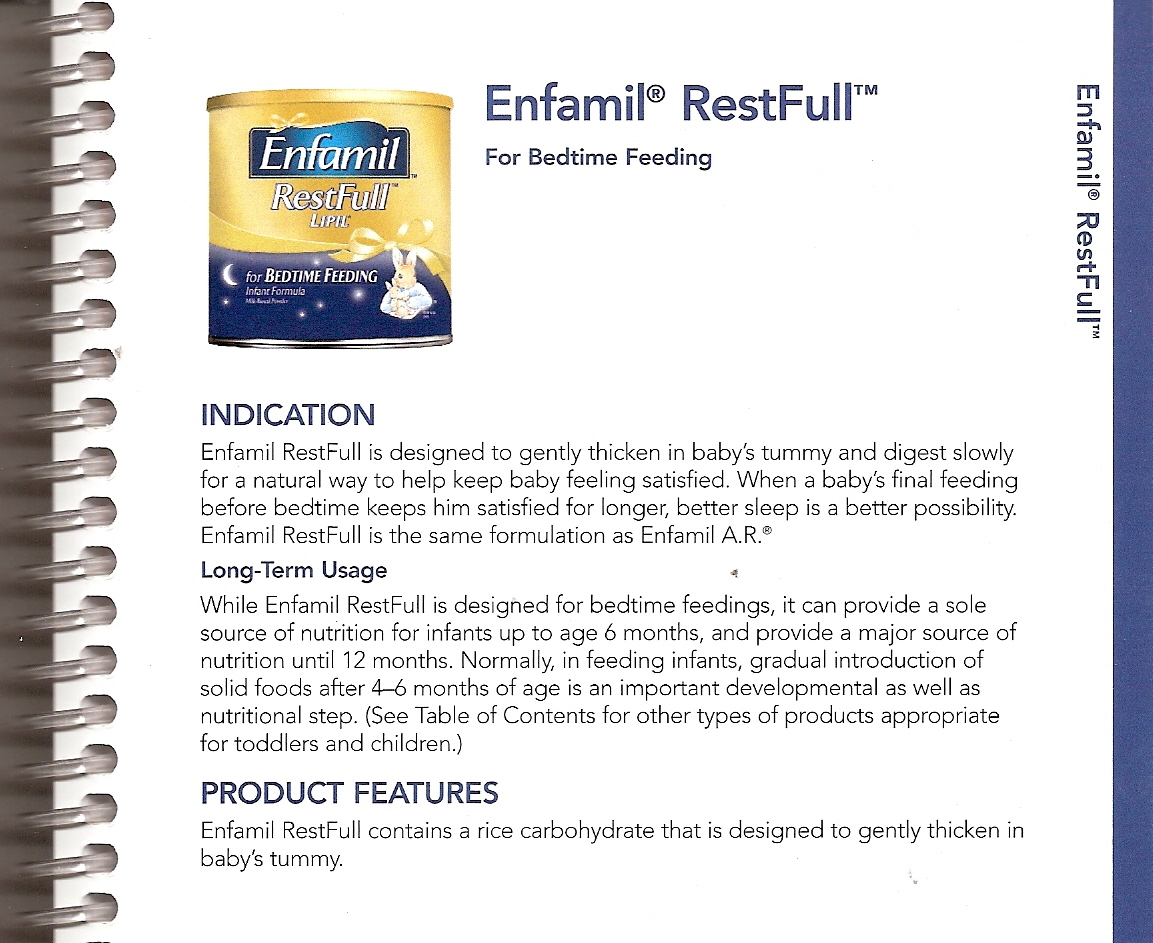
The 2010 Pediatric Products Handbook by Mead Johnson boasted of a "new" formula.  What is this brand new miracle in a can?  It's a sleep aid for children.  Well, it doesn't read exactly like that, but the actual words under "Product Features" are even more frightening.  I photographed the page, because as skeptical as I am, I would want to see it for myself and I believe my readers deserve the same consideration.
The product, Enfamil Restful "contains a rice carbohydrate that is designed to gently THICKEN IN BABY'S TUMMY."  They say it like it's a good thing!   Enfamil is marketing this product "For Bedtime Feeding."


The product claims that this is a "natural way to help keep baby feeling satisfied"...it's all there, read it...as many times as it takes to believe it.  Since when is throwing starch into a bottle "natural"?  
As you are still shaking your head, read the section about "Long-Term Usage"...yep, they say it..."it can provide a sole source of nutrition for infants UP TO AGE 6 MONTHS! Moms are being encouraged to start their newborn out on this stuff in order to make "better sleep a better possibility."  This formula is also available at local WIC agencies.  I think more counseling needs to be done during appointments concerning this product.

What problems do I see with this marketing scheme?  Where do I start?  First, we are setting moms up to think babies are supposed to sleep through the night.  Most of us know, or have heard, about the importance of brain development during the waking hours.  We should not encourage newborns to go several hours without waking right after they are born.  This is detrimental to their growth and development.

Also, formula is supposed to mimic the gold standard, which of course is human milk.  What do we know about human milk and digestion?  The proteins in breastmilk are easily digested and human milk is processed quickly--requiring regular feedings (small, frequent meals--spaced out throughout the day--is even a recommendation for children and adults).  These small, regular feedings do not require the stomach to stretch to hold an abundance of food that must be processed over a long period of time.  Formula is far-from replicating breastmilk in this instance.

This type of formula and teaching is contributing to the obesity problem in our country.  A big meal before bed and letting an infant "sleep it off" is absolutely ridiculous.  

Why do I think Mead Johnson created this formula...because moms wanted it and it would be a huge money maker.  Parents are exhausted.  They want and need sleep.  Then they hear about a company that makes a product that will "help them get better sleep..." and the geniuses in the marketing division have a slogan to get these cans flying off the shelves.

The funny thing is, this formula has been around quite awhile.  Look back at the printed page.  Let me draw your attention to the bottom of the first paragraph.  "Enfamil Restfull is the same fourmulation as Enfamil A.R."  Really, this miracle has been around?  Yes, and it was successful at helping with spit up and doctors would often recommend it for reflux...okay, so why wasn't it a best seller?  The name.  Parents may not remember what AR does and what it stands for, but "Restfull" they understand.  Sleep...that's a word they would like to have back in their vocabulary, so... "A Star is Born" a gold star...confusing parents and causing them to rely on a sleep aid for their child.  The company did not invent anything new, they re-purposed something old...gave a face lift to a can, revived a recipe with a "sleep better" slogan.

What's in this can that helps a baby sleep so well?  According to the rules of ingredients, let's just check out the first four, to see what constitutes the greatest percentage of this product:
  1. Nonfat milk
  2. Vegetable oil
  3. Rice starch
  4. Lactose
Okay, it may make an infant sleep better at night, but I sure couldn't sleep knowing I had given this to my baby.  It is crucial that we educate well-meaning parents about the marketing tactics being used on them.  Parenting is a difficult job...we lose sleep when our children are infants, when they have the flu, when it's thundering outside, when they learn to drive...parents will have some sleepless nights and sacrifice a lot more than sleep for their children, but what they get in return is priceless.


It is not my goal to target formula in general, but the deceptive marketing strategies being used on new parents.  I believe we must be informed in order to make "informed decisions."  I hope you can use this information as a teaching tool for prenatal and new moms.  I have not had a mom, nutritionist or dietitian disagree with me about my concerns once I shared this information with them...share...inform...support...

If families need additional breastfeeding help, share a link with them or encourage them to contact a Lactation Consultant.

I have some more marketing and advertising tactics I am looking forward to sharing in the near future.  Stay tuned as I reveal what I have found in my research...

Christy Jo Hendricks, IBCLC, RLC CD(DONA), CLE
www.birthingandbreastfeeding.com


I will be providing a CAPPA CLE Training in October.  Would love to have more Lactation Educators sharing this information.  Find out about the Training on my Website.